
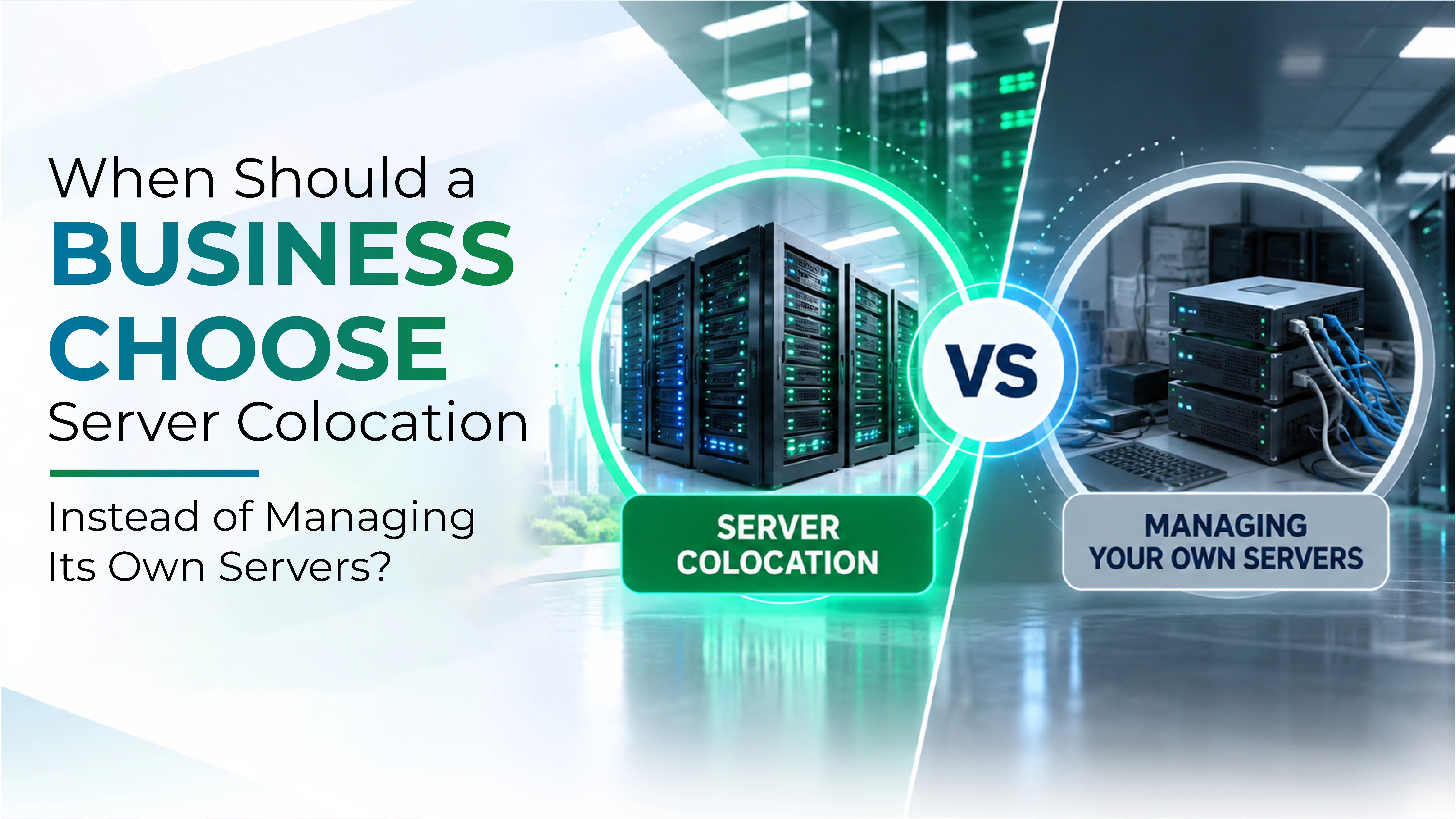
For many growing businesses, the moment arrives when the server room down the hall stops being an asset and starts being a liability. Server colocation offers a compelling alternative by moving your physical hardware into a professionally managed data center facility while retaining full ownership and control of your equipment.
Whether that shift makes sense for your organization depends on a handful of factors that most IT managers quietly wrestle with for longer than they should.
What Server Colocation Actually Means
Server colocation means placing your company-owned servers inside a third-party data center that supplies the power, cooling, physical security, and network connectivity. You own and manage the hardware; the facility handles everything around it. Think of it as renting a highly engineered environment rather than buying the real estate.
This is a meaningful distinction from cloud hosting, where you neither own the hardware nor control the underlying infrastructure. With colocation, your servers are your servers — you can upgrade them, configure them, and move them if your contract ends.
The Real Cost of Running Your Own Infrastructure
This is where most business cases for colocation quietly win before the conversation even gets going. The visible costs of an on-premises server room, including hardware, licensing, and IT staff, are easy to budget for. The invisible ones are not.
Power is the first surprise. A modest on-premises setup running multiple servers can consume significant power continuously. At commercial electricity rates, that's a meaningful line item before you factor in redundant UPS systems, backup generators, and the HVAC capacity to prevent thermal events. Cooling can also represent a significant portion of a data center’s overall energy consumption, and a business-grade server room is no different.
Then there's the infrastructure beneath the infrastructure. Redundant fiber connections, physical access controls, fire suppression systems, and around-the-clock monitoring don't come free. Many mid-sized companies discover, when they add it up honestly, that maintaining this infrastructure in house requires significant investment. A professional colocation facility can distribute these infrastructure costs across multiple customers, making the model more efficient and predictable.
The math rarely favors keeping it in-house.
Signs Your Business Has Outgrown Its Server Room
Not every company reaches this inflection point at the same time. But there are patterns.
The most obvious signal is capacity pressure. When rack space runs out, the next option is leasing more office square footage just to house equipment. That's a misallocation. Office space is priced to house humans, not servers, and the per-square-foot cost for a proper data center environment is orders of magnitude lower when properly shared.
Uptime requirements are often the sharper catalyst. A business that once tolerated occasional maintenance windows can no longer afford them. As organizations mature, their SLA expectations climb. 99.98% uptime sounds impressive until you're the one explaining a 9-hour annual outage window to a client with a zero-downtime contract. Professional colocation facilities typically guarantee 99.989% uptime, backed by N+1 or 2N redundancy in power and cooling.
Hiring is also a constant friction point. Requiring 24/7 on-call coverage for physical infrastructure means either burning out your existing team or adding headcount whose primary job is babysitting hardware. That's not a strategic use of engineering talent.
When Server Colocation Makes the Most Sense
The strongest case for server colocation is when your business has made a significant hardware investment that isn't going anywhere, such as custom-built servers, specialized GPUs, or high-memory compute clusters, but your existing facility can't support the operational requirements those assets demand.
Financial services, healthcare organizations, and SaaS companies operating in regulated environments find colocation particularly attractive because reputable facilities come pre-certified for compliance frameworks like SOC 2, ISO 27001, and HIPAA. Building that compliance posture from scratch in a private facility is expensive and slow. Inheriting it through a qualified colocation partner is neither.
Disaster recovery is another decisive factor. A company with all its infrastructure in a single building, especially one in a flood zone, hurricane corridor, or earthquake-prone region is carrying concentration risk that a board should not be comfortable with. Colocation, particularly across geographically distributed facilities, solves this structurally rather than procedurally.
Colocation vs In-House Servers: A Practical Comparison
The colocation vs in-house servers debate often gets framed as a cost question, but operational resilience is the more important variable for most businesses.
In-house infrastructure gives you maximum control and zero dependency on a third-party facility. That matters in specific contexts, such as highly classified environments, air-gapped systems, or organizations with extremely unusual physical security requirements. For those cases, in-house can be the right answer, and it's worth saying plainly.
But for most businesses, in-house servers mean accepting trade-offs such as limited redundancy, single-point power exposure, constrained physical security, and the perpetual staffing overhead of maintaining a live environment around the clock. Colocation addresses all of these by design. The facility was built to solve exactly these problems at scale.
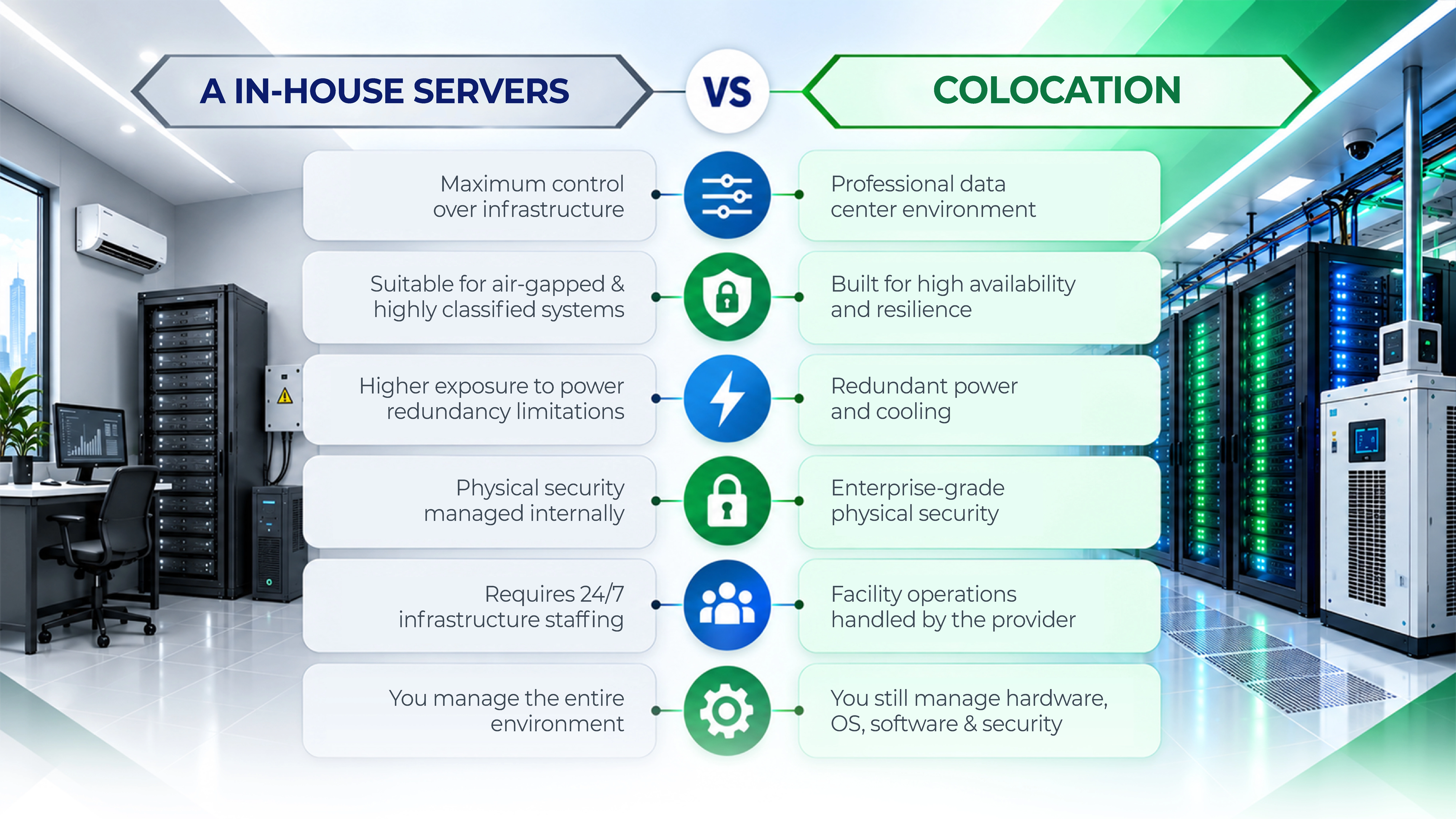
Colocation doesn't automatically reduce complexity. You still manage your hardware, your OS stack, your software, and your security posture above the physical layer. If your team lacks the expertise to manage that layer, colocation may expose gaps that were previously hidden by proximity. Moving equipment to a data center doesn't move the operational knowledge requirements with it.
What to Look for in a Colocation Provider
Not all colocation facilities are equal. Tier classification matters because a Tier III facility offers concurrently maintainable infrastructure, meaning no component is a single point of failure. Tier IV offers fault tolerance on top of that. For most businesses, Tier III is the realistic target and a meaningful upgrade over a typical on-premises environment.
Beyond certification, network carrier diversity is non-negotiable. A facility connected to a single upstream provider is not meaningfully more resilient than your current setup. Look for multiple Tier 1 carriers, direct peering options, and low-latency connectivity to your primary markets.
Physical security specifics matter more than people expect. Biometric access, man-traps, CCTV with retention, and strict visitor protocols are the baseline, not differentiators. Any serious colocation vendor should demonstrate these without being asked.
Why Slivernox Is Built for This Conversation
Slivernox is a data center company that approaches server colocation as an engineering discipline rather than a real estate transaction. The infrastructure is designed around the operational realities of businesses that can't afford surprises. This includes redundant power feeds, carrier-neutral connectivity, physical security protocols that meet enterprise and regulated-industry standards, and a support model that doesn't disappear after the contract is signed.
For IT managers evaluating a move away from in-house servers, the practical question isn't whether colocation is theoretically better. The question is whether the provider can hold the environment to the standards the business actually requires. Slivernox builds its facilities and its relationships around that question.
If you're at the stage where your infrastructure is outpacing your ability to manage it reliably, contact Slivernox to discuss what a colocation arrangement would look like for your specific environment, including hardware footprint, compliance requirements, redundancy needs, and all.
Frequently Asked Questions
What is server colocation and how does it differ from cloud hosting?
Server colocation means placing your own physical servers in a third-party data center that provides power, cooling, security, and network connectivity. Unlike cloud hosting, you own and control the hardware — the data center only manages the physical environment around it. This distinction matters when hardware customization, data sovereignty, or specific compliance requirements are involved.
How do I know if colocation is more cost-effective than managing my own servers?
A useful starting point is tallying the full cost of your current on-premises setup: power consumption, cooling, physical security, fiber connectivity, maintenance contracts, and the staff time dedicated to infrastructure operations. For many mid-sized businesses, this figure runs well above initial estimates. A colocation provider amortizes those same infrastructure costs across many tenants, which generally produces a lower per-unit cost for equivalent reliability.
What uptime guarantees should I expect from a colocation provider?
Reputable colocation facilities typically offer 99.989% uptime guarantees on the physical infrastructure — power, cooling, and network. This translates to roughly five minutes of unplanned downtime per year. Tier III and Tier IV facilities achieve this through redundant systems designed to be maintained without service interruption. Compare this against a typical business-managed server room, which rarely carries formal uptime commitments at all.
What happens to my data and servers if a colocation provider goes out of business?
Your hardware remains your property. In the event a colocation provider ceases operations, you retain the right to remove your equipment, and reputable contracts include provisions for advance notice and transition periods. This is one reason why reviewing contract terms — particularly around data access, termination clauses, and equipment retrieval — matters as much as evaluating the facility itself.
Does colocation help with regulatory compliance requirements?
Yes, meaningfully. Established colocation providers invest heavily in certifications such as SOC 2 Type II, ISO 27001, and HIPAA-compliant physical controls. Organizations in financial services, healthcare, or other regulated industries can inherit a significant portion of their physical infrastructure compliance posture through a qualified colocation partner rather than building it independently.
Is server colocation suitable for small businesses, or only for larger enterprises?
Colocation scales more broadly than most people assume. While large enterprises benefit from moving entire data halls, smaller businesses can colocate a few racks — sometimes even a single cabinet — and gain access to the same power redundancy, physical security, and network infrastructure. The value proposition is strongest when uptime requirements or compliance obligations exceed what an in-house environment can realistically support, regardless of company size.
How much hands-on access will I have to my servers in a colocation facility?
Access policies vary by provider, but standard arrangements include scheduled on-site visits with advance notice, 24/7 remote hands support for tasks like reboots or cable management, and out-of-band management options such as KVM-over-IP. You should expect physical access to be structured and logged rather than walk-in, which is both a security feature and, occasionally, an operational friction point worth planning around.