
Best Colocation Services in Mumbai: Complete Selection Guide

Mumbai isn't just India's financial capital — it's the backbone of the country's commercial infrastructure, and there's a reason for that.
If your organization runs critical workloads, handles financial transactions, or serves users across India, picking the right colocation partner in Mumbai can genuinely be the line between resilient uptime and an expensive outage.
This guide skips the sales talk and gives IT managers and CTOs a practical way to evaluate providers against what actually matters for their operations.
Table of Contents
- Why Mumbai Dominates India's Colocation Market
- Key Criteria for Evaluating Colocation Services in Mumbai
- Understanding Colocation Pricing in Mumbai
- Connectivity and Network Ecosystem
- Compliance, Certifications, and Physical Security
- Common Mistakes IT Leaders Make When Selecting Colocation Services in Mumbai
- Why Silvernox
- Frequently Asked Questions
Why Mumbai Dominates India's Colocation Market
No other Indian city combines submarine cable landings, financial sector density, and network exchange points quite the way Mumbai does. It sits right at the intersection of several undersea cable systems linking Asia, Europe, and the Middle East — which means low-latency international connectivity that Bengaluru and Hyderabad just can't compete with for global traffic.
India's BFSI sector, including banking, financial services, and insurance, is concentrated in Mumbai's business districts. If you're serving that ecosystem, being close to exchanges, regulators, and financial counterparties isn't a nice-to-have; it's a competitive requirement. And because the data center near Mumbai benefits from this concentration, the network peering fabric here is far richer than anywhere else in the country.
Demand has picked up noticeably over the past three years. Cloud repatriation, data localization mandates, and a wave of digital-first companies are all driving it. Supply is catching up, but the quality across providers still varies a lot.
Key Criteria for Evaluating Colocation Services in Mumbai
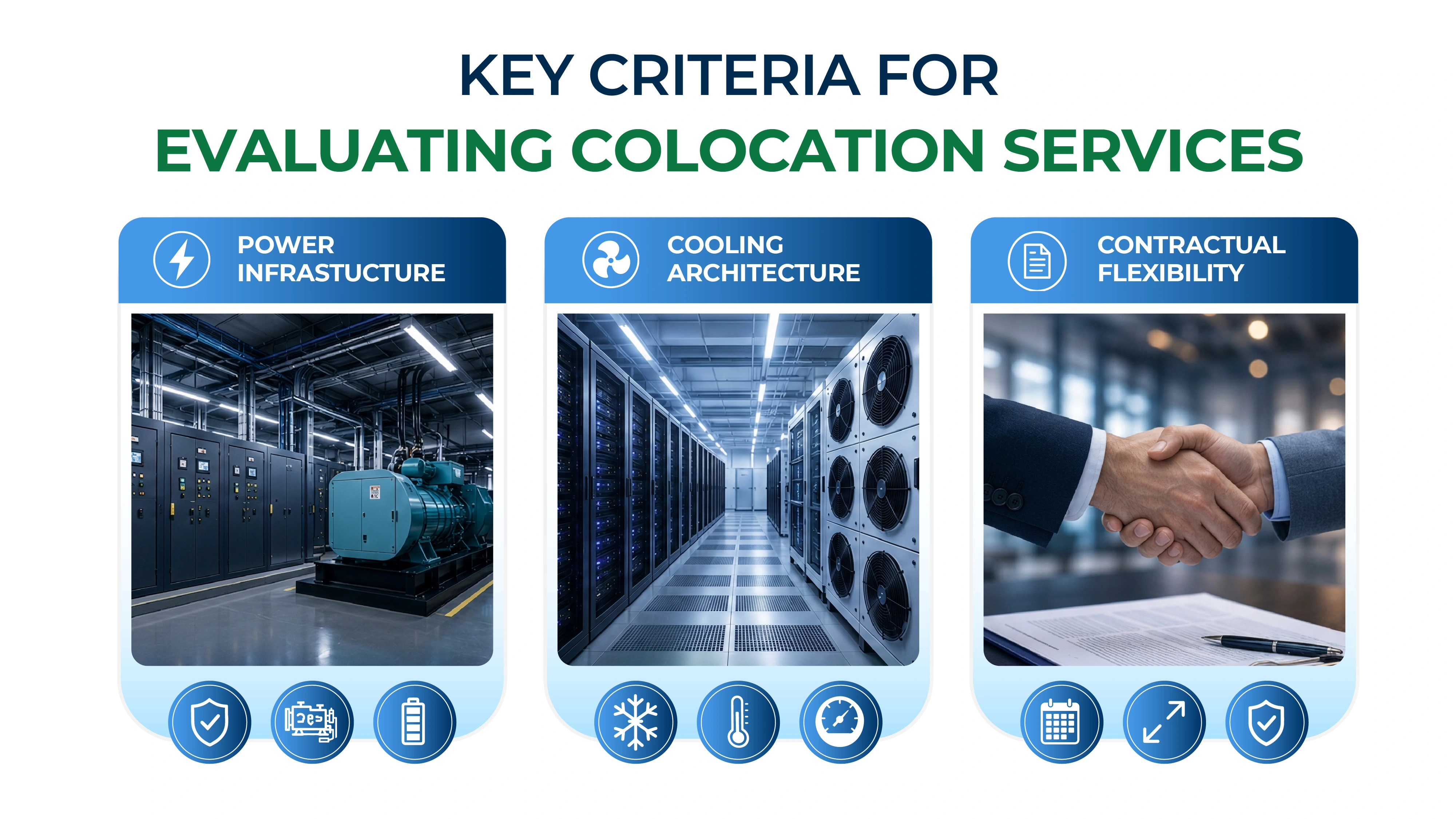
Skip the marketing and focus your due diligence on three things:power reliability, cooling architecture, and how flexible the contract actually is.
Power Infrastructure
A Tier III facility promises 99.982% uptime on paper. But what actually protects your equipment is the engineering behind that number. Ask providers directly about their UPS redundancy setup (N+1 or 2N), their generator fuel contracts, and this matters, how many times they've actually had to fail over to generator power in the last year. If a vendor can't answer that with specifics, that's a red flag worth noting.
Power density is becoming a bigger deal than it used to be. A lot of older Mumbai facilities were built for three to five kilowatts per rack. If GPU servers, high-density storage, or AI workloads are anywhere on your roadmap, check that the facility can handle ten to twenty kilowatts per rack without forcing a costly upgrade mid-contract.
Cooling Architecture
Mumbai's heat and humidity make thermal management harder here than in cooler climates. Hot aisle/cold aisle containment should be the baseline now, not something you pay extra for. If a facility is still running open-floor cooling without containment, that's a structural inefficiency that'll catch up with your equipment eventually.
Lock-in is the risk nobody talks about enough. Three-year terms with steep exit penalties are common, but they're negotiable more often than people assume. Push for SLAs with actual financial remedies, not service credits buried behind a dispute process, and make sure the contract spells out exactly what power, space, and connectivity you're paying for.
Understanding Colocation Pricing in Mumbai
Pricing generally comes down to three things: cabinet space, power draw, and cross-connects. Cross-connects are one of those costs people forget to budget for. Hooking up to a cloud platform or a carrier inside the facility usually isn't free, and if your setup depends on more than one connection, those charges pile up faster than you'd expect. Better to build them into your budget upfront than get surprised by them later.
It also pays to look past the number on the initial quote. A cheaper price can mean fewer carrier choices, higher power costs, older hardware, or thinner support — trade-offs that don't show up until you're already locked in. Rather than chasing the lowest sticker price, it's worth weighing the real value, reliability, and efficiency a provider delivers over the life of the contract.
Connectivity and Network Ecosystem
Connectivity is arguably the most important differentiator among Mumbai's colocation providers, and this is where the gaps between facilities become most visible.
Carrier-neutral facilities give you real leverage. When one provider controls all the network options in a building, you lose both negotiating power and redundancy at the same time. A solid data center near Mumbai should give you access to somewhere between eight and twelve carriers — Tier-1 providers, ISPs, and direct on-ramps to AWS, Azure, and GCP.
Internet Exchanges
Mumbai hosts DE-CIX India and other peering points that let networks exchange traffic with minimal latency. Facilities with direct access to these exchanges give you a real latency edge for Indian users. If you're running anything latency-sensitive such as payments, gaming, or real-time analytics, this isn't optional.
Compliance, Certifications, and Physical Security
India's regulatory landscape keeps shifting. The Digital Personal Data Protection Act changed how organizations need to think about data residency and access control, and RBI has its own requirements for BFSI entities outsourcing IT infrastructure. Your colocation provider's compliance posture is your compliance posture.
Look for ISO 27001 certification as a baseline. SOC 2 Type II reports, while more common among US-headquartered providers, are increasingly available from mature Indian operators. If you're in BFSI, ask specifically about RBI-compliant audit trails and whether the provider has experience hosting regulated workloads.
Physical security deserves more attention than most buyers give it. Mantrap entries, biometric access tied to named individuals, CCTV retention policies, and visitor escort procedures are the physical layer of your data security architecture. Walk the facility before signing anything.
Common Mistakes IT Leaders Make When Selecting Colocation Services in Mumbai
The costliest mistake is treating colocation as a commodity purchase and selecting on price alone. Saving a few thousand rupees a month on rack fees can be obliterated by a single unplanned outage or a network incident that disrupts customer-facing services for hours.
The second mistake is underspecifying power. Many IT teams calculate current power needs and sign contracts accordingly, without accounting for hardware refreshes or workload growth over the contract term. Always build in a 30% to 40% headroom buffer.
And the third, most avoidable mistake is not visiting the facility in person. Every sales deck looks polished. It's the physical walkthrough that tells you the real story: how organized the floor is, whether cabling is clean, whether the staff on duty actually know the infrastructure. Those details tell you a lot about how your 2 a.m. escalation is going to go.
Why Silvernox
Silvernox is built specifically for enterprises that need more than just a rack in Mumbai — they need an operator who actually understands what running critical infrastructure requires. The facility is Tier III, carrier-neutral, and designed around resilient power and fast connectivity, with a compliance-ready setup that works for BFSI, healthcare, and technology companies alike.
What really sets Silvernox apart is its hands-on technical approach before you even sign anything. The team works closely with you to understand your actual deployment needs before implementation, helping organizations build infrastructure that is secure, scalable, and operationally reliable.
If you're weighing colocation options in Mumbai, Silvernox brings both the technical depth and the physical infrastructure to support your business growth.