
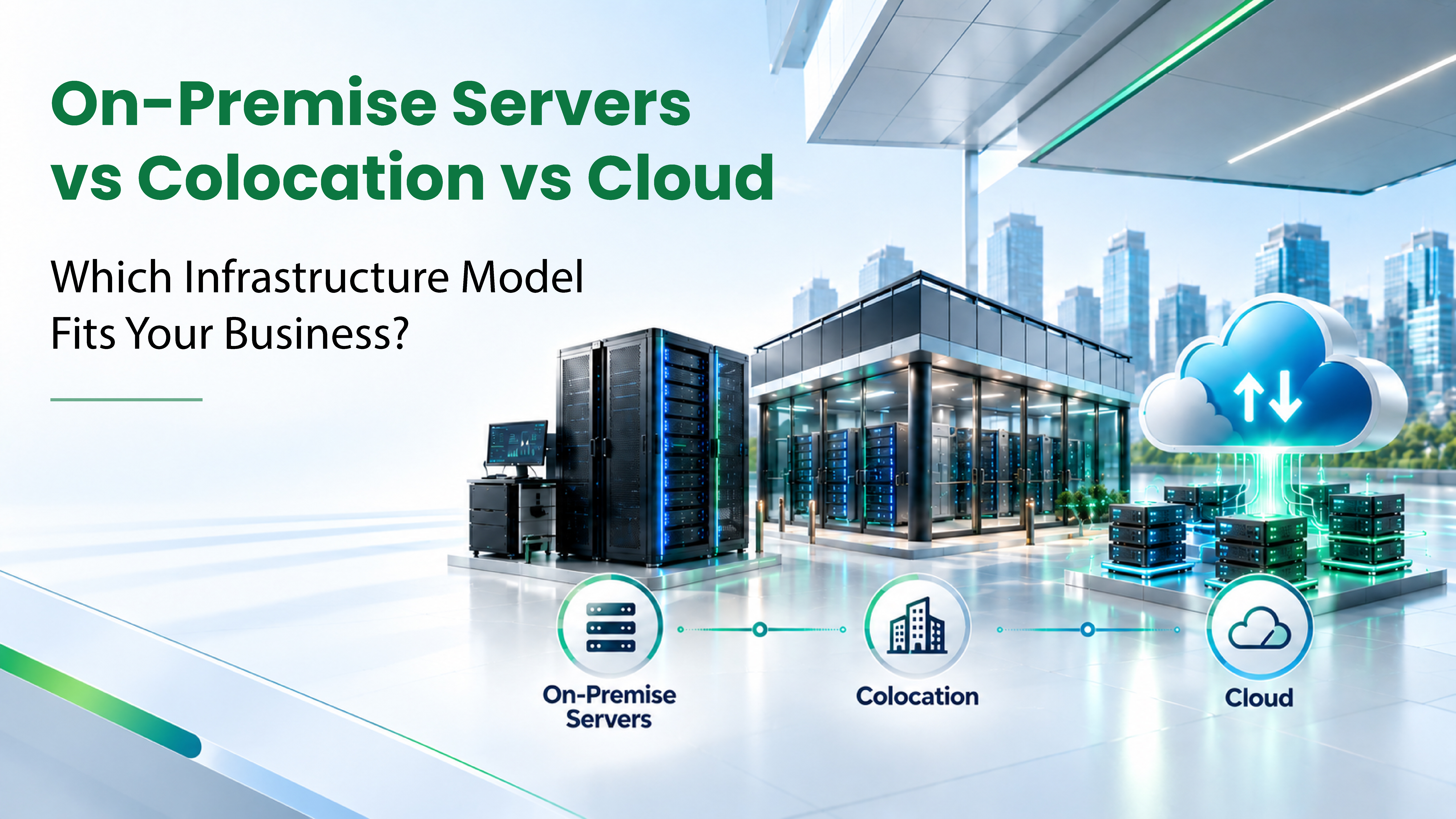
Every infrastructure decision your organization makes today will shape its operational flexibility, cost structure, and security posture for the next five to ten years. The choice between on-premise servers, colocation, and cloud is no longer just a technical question.
It is a strategic decision with financial and operational consequences that extend well beyond the IT department. Before you sign a contract or install a server, you need a clear and honest understanding of what each model actually offers.
What Each Model Actually Means
These three terms get used loosely, and that lack of clarity leads to bad decisions. So let's establish clean definitions before comparing anything.
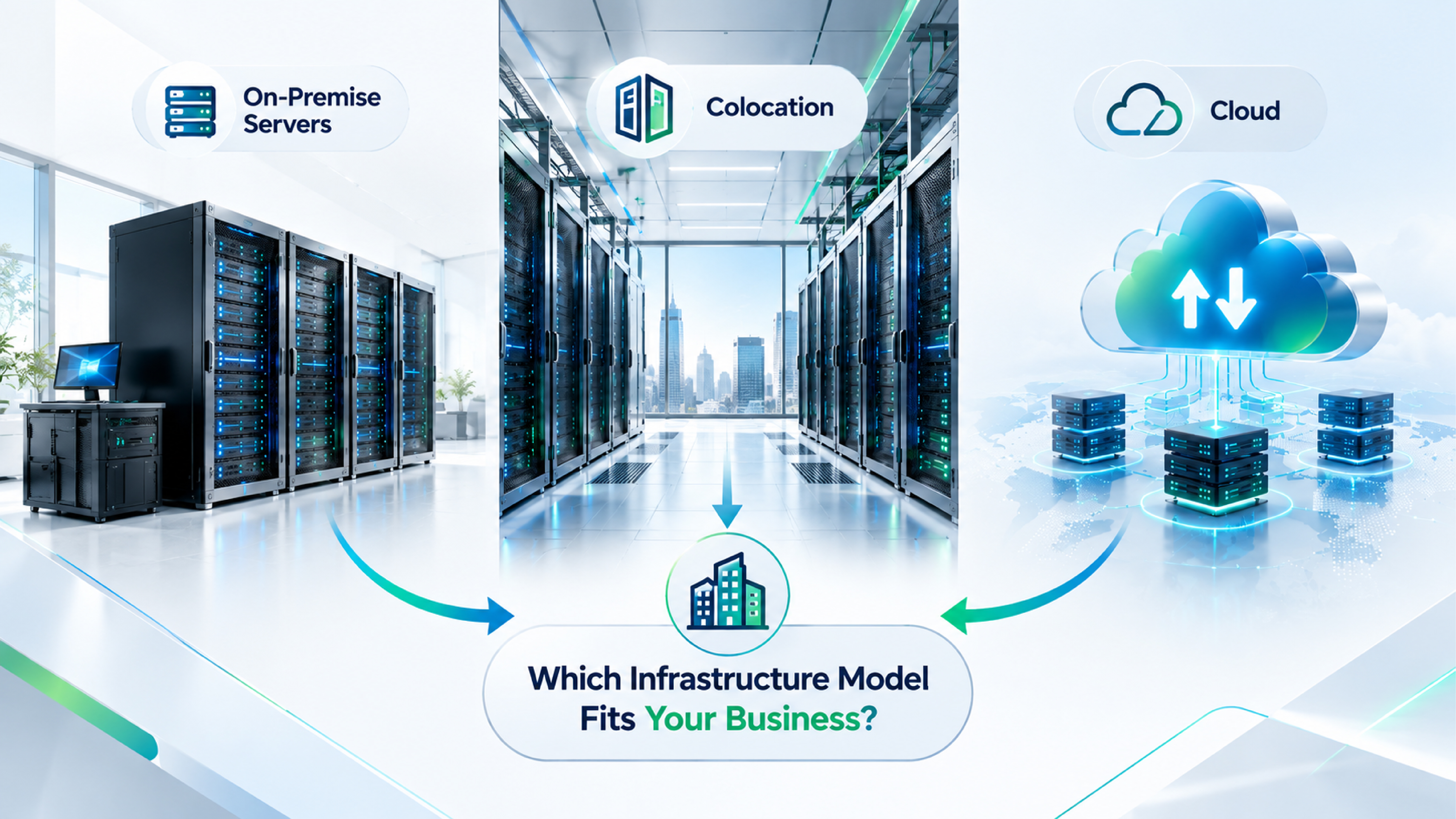
On-premise means your organization owns the hardware, houses it in your own facility, and manages every layer of the infrastructure. This includes power, cooling, physical security, networking, and software. You bear all capital expenditure upfront and all operational responsibility in perpetuity.
Colocation means you own the hardware but rent space inside a purpose-built data center. The facility provider, such as Slivernox, handles power redundancy, cooling infrastructure, physical security, and connectivity. You manage the servers themselves. This division of labor often gets overlooked in server hosting comparisons.
Cloud means you own nothing. You rent compute, storage, and networking from a hyperscaler like AWS, Azure, or Google Cloud. This model offers significant flexibility and agility, but you are also renting forever, at prices set by someone else.
On-Premise Servers vs Colocation vs Cloud: Where the Real Costs Live
Cost is where most infrastructure conversations start, and where most of them go wrong. The numbers look obvious on the surface but hide significant complexity underneath.
On-premise carries the heaviest upfront burden. A reasonably capable server room for a mid-sized organization requires UPS systems, precision cooling, fire suppression, redundant power feeds, physical security, and other supporting infrastructure before installing the servers themselves. The organization is also responsible for ongoing maintenance, upgrades, repairs, and operational issues. When critical infrastructure fails, the organization is solely responsible for resolving the problem.
Colocation flips that model. You spend capital on hardware you own and control, but you're paying a monthly or annual fee for space, power, and connectivity. Facilities such as Silvernox operate at a scale that can provide infrastructure that would be difficult for an individual organization to replicate economically. This can include N+1 or 2N power redundancy, enterprise grade cooling, physical security, and multi carrier connectivity. You get enterprise data center infrastructure without the enterprise infrastructure budget.
Cloud shifts everything to operating expenditure, which sounds appealing until you run the three-year TCO calculation. For workloads with predictable, steady-state resource consumption, cloud costs consistently outpace colocation costs by a factor of two to four. That's not a theoretical concern; it's a pattern that CIOs have discovered after committing to public cloud and then quietly repatriating workloads.
The honest practitioner's position is that cloud is expensive for stable workloads, and the organizations that don't model this carefully will overpay for years before they notice.
Security and Compliance: Who Controls What
Control over your data's physical location matters, not just philosophically, but practically in a regulatory context.
On-premise gives you maximum physical control but requires you to engineer and audit every security layer yourself. For highly regulated industries like healthcare, financial services, or defense contracting, this can mean significant ongoing investment in physical security audits, access logging, and environmental monitoring. You own the compliance story entirely, which is either a strength or a liability depending on your team's capabilities.
Colocation offers a hybrid posture. Slivernox maintains SOC 2-aligned physical security, redundant surveillance, biometric access controls, and audit trails that feed directly into your compliance documentation. Your hardware stays yours; specialists manage the secure envelope around it. For compliance teams, this is often the cleanest arrangement, with third-party attestation of physical controls without surrendering data sovereignty.
Cloud introduces jurisdictional complexity that is frequently underestimated. Data residency in public cloud requires careful configuration and ongoing verification. Shared-responsibility models mean the provider secures the infrastructure, but misconfiguration risk, which accounts for the vast majority of cloud data breaches. sits with you.
Performance and Latency — The Argument Colocation Quietly Wins
Raw latency is a function of physics. Your servers' physical distance from your users and from your interconnection points determines the floor beneath which performance cannot drop.
For applications where single-digit millisecond latency matters, such as financial trading platforms, real-time manufacturing systems, and high-frequency data processing, colocation inside a well-connected facility is difficult to beat. Slivernox's data center connectivity gives customers direct access to major internet exchanges and carrier-neutral cross-connects, compressing latency in ways cloud regions simply cannot match for localized workloads.
On-premise can theoretically match this for purely internal traffic. But the moment data needs to traverse public internet to reach partners, customers, or remote locations, you're at the mercy of your ISP's peering agreements. Colocation inside a carrier-neutral facility solves that cleanly.
When Cloud Is the Right Answer (And When It Isn't)
Cloud earns its place for specific use cases, and it's worth being precise about what those are.
Variable, spiky workloads are cloud's natural territory. If your compute needs jump tenfold during a product launch or quarter-end processing and then collapse back to baseline, the elasticity of cloud prevents you from over-provisioning hardware that sits idle 90% of the year. Development and test environments, disaster recovery secondaries, and globally distributed applications also benefit from cloud's geographic reach and managed service ecosystem.
But steady-state production workloads, including databases, application servers, and storage systems with predictable throughput, are chronically overcharged in cloud environments. The server hosting comparison changes dramatically when you model three years of cloud spend against three years of owned hardware in colocation. Owned hardware wins on unit economics almost every time.
And there's a dependency risk that rarely appears in cloud vendor conversations. When you run everything in one hyperscaler's environment, your operational continuity depends on their availability, pricing decisions, and roadmap. That concentration risk is real.
On-Premise Servers vs Colocation vs Cloud: How to Choose for Your Organization
No single model fits every organization, but the decision framework is straightforward once you stop treating it as a binary choice.
Start by segmenting your workloads by variability, latency sensitivity, compliance requirements, and projected three-year cost. Most organizations will find that colocation is the right home for their core production infrastructure, cloud handles variable and distributed workloads, and on-premise survives only where regulatory requirements mandate it or where specific air-gap requirements exist.
The on-premise servers vs colocation vs cloud question is really a portfolio question. The organizations making the best infrastructure decisions right now aren't choosing one. They're allocating deliberately across all three based on workload characteristics.
Why Slivernox Belongs in This Conversation
Slivernox is built for organizations that have moved past the phase of treating infrastructure as an afterthought. The Slivernox data center offers carrier-neutral colocation with enterprise-grade power redundancy, physical security, and flexible connectivity options designed to support hybrid infrastructure strategies at any scale.
For CTOs and IT managers who are rationalizing their infrastructure footprint, whether that means migrating away from aging on-premise hardware, repatriating workloads from public cloud, or building a hybrid architecture from scratch. Slivernox provides the physical foundation without the overhead of building and operating your own facility.
The Slivernox team works directly with technical stakeholders to design colocation arrangements that match actual workload requirements, not just rack-and-stack your hardware and hand you a key.
If your organization is at a decision point on infrastructure strategy, contact the Slivernox team to discuss your workload requirements and get a clear picture of what colocation could look like for your environment. A direct conversation with an infrastructure specialist is far more useful than a generic cost calculator.
Frequently Asked Questions
What is the main difference between colocation and cloud hosting?
In colocation, you own the physical servers and rent space, power, and connectivity inside a data center. In cloud hosting, you own nothing — you rent virtualized compute and storage from a provider. Colocation typically costs less over a three-year horizon for stable workloads, while cloud offers more flexibility for variable or short-term resource needs.
Is on-premise infrastructure still worth considering in 2025?
For most organizations, on-premise makes sense only when regulatory requirements mandate complete physical control or when specific air-gap requirements exist. The capital and operational costs of running your own facility have become difficult to justify when colocation offers equivalent control at lower total cost with better physical infrastructure than most organizations can build themselves.
How does the on-premise servers vs colocation vs cloud decision affect compliance?
Each model carries different compliance implications. On-premise puts all physical control and audit responsibility on your team. Colocation facilities like Slivernox provide third-party-attested physical security controls, which simplifies compliance documentation for frameworks like SOC 2, HIPAA, and PCI DSS. Cloud introduces shared-responsibility models and data residency complexities that require careful configuration and ongoing verification.
What workloads are best suited for colocation?
Colocation is particularly strong for latency-sensitive production applications, high-throughput databases, workloads with predictable resource consumption, and any environment where data sovereignty or physical hardware ownership matters. Organizations in financial services, healthcare, manufacturing, and media production frequently find colocation the most cost-effective and performant option for their core infrastructure.
What happens if I outgrow my colocation space?
Reputable colocation providers plan for growth. Scaling in colocation typically means adding cabinets, increasing power allocation, or expanding cross-connects — all of which can be handled without a hardware procurement cycle. The lead time is significantly shorter than building out new on-premise space, and shorter than waiting for cloud reserved instance terms to expire.
How do I calculate whether cloud or colocation is more cost-effective for my workloads?
Model a 36-month total cost of ownership that includes hardware amortization, colocation fees, and network costs on one side, and three years of on-demand or reserved cloud pricing on the other. For workloads running at consistent utilization above roughly 40–50%, owned hardware in colocation will almost always produce a lower three-year cost. The calculation changes for workloads with high variability or short-term horizons.
What should I ask a colocation provider before signing a contract?
Ask about power redundancy architecture (N+1 vs 2N), physical security certifications and audit history, carrier options and whether the facility is carrier-neutral, SLA terms for power and cooling uptime, and the process for after-hours access. Also ask specifically about the escalation path when something goes wrong — the answer to that question tells you more about a provider's operational maturity than any marketing material will.