
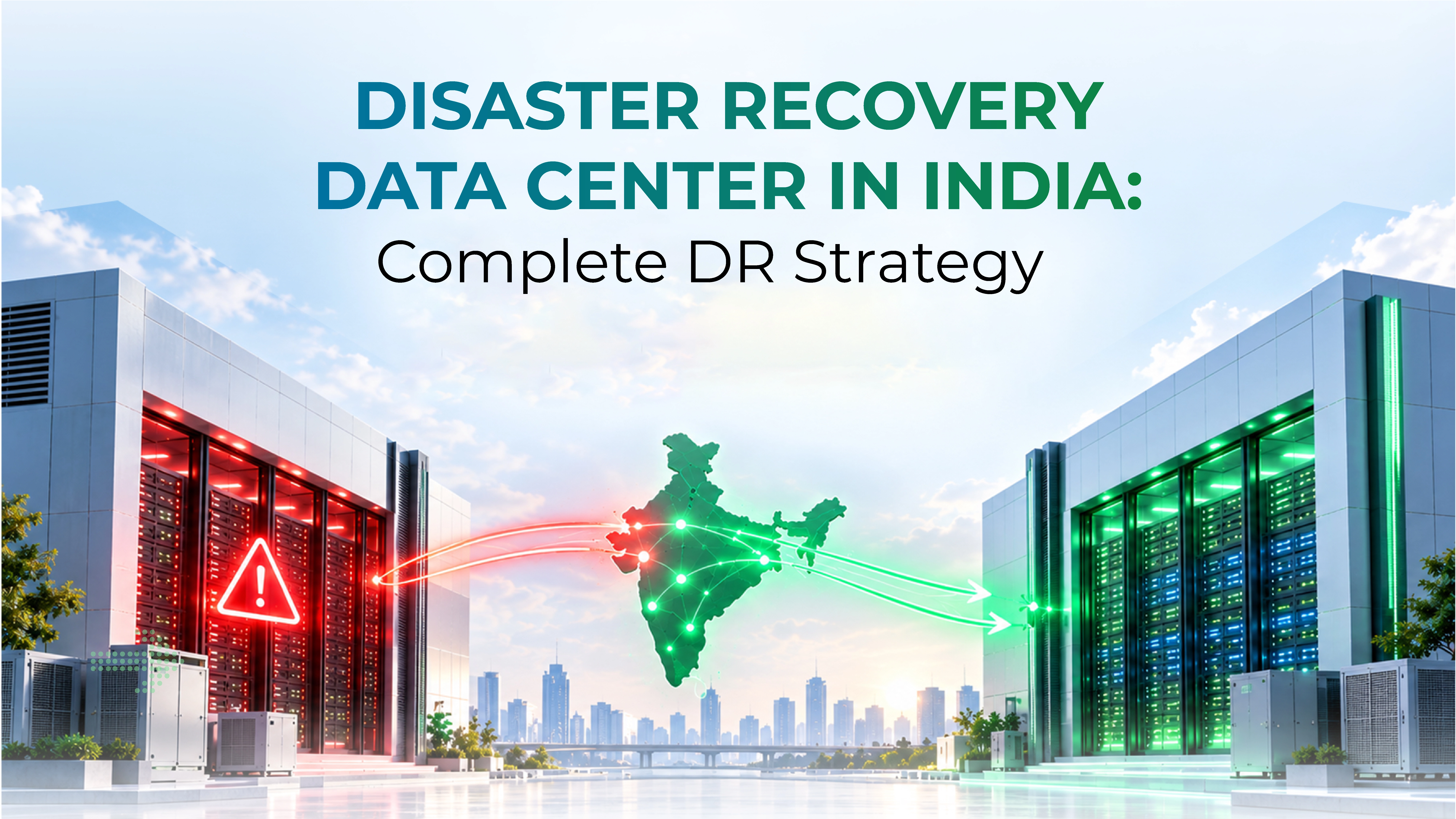
Indian enterprises are learning an expensive lesson. A good backup policy is not the same as a disaster recovery plan. When a power grid failure, a flood in a coastal zone, or a ransomware incident takes down a primary facility, the question is never whether you had backups.
The real question is whether your business can actually resume operations within a timeframe your customers and revenue can survive. A purpose-built disaster recovery data center answers that question before the crisis arrives.
Why Indian Enterprises Need a Dedicated DR Site
India's digital infrastructure has grown faster than many organizations have been able to strengthen their resilience. Many mid-sized enterprises still rely on a single production site without a reliable failover strategy.
The regulatory environment is also tightening. SEBI, RBI, and IRDAI now mandate specific recovery time objectives for financial institutions, and the Digital Personal Data Protection Act 2023 raises the stakes for data availability and integrity across sectors. Compliance aside, the commercial pressure is real. An hour of downtime for a mid-market e-commerce operation can represent losses in the range of lakhs of rupees, depending on traffic volume and the season.
A disaster recovery data center is not optional infrastructure for organizations operating at scale in India. It's the floor beneath everything else.
Core Elements of a Disaster Recovery Plan That Actually Works
Most disaster recovery plans fail not during a disaster but months before one, when no one is updating them. A written plan that hasn't been tested or revised since your last major infrastructure change is worse than no plan, because it creates false confidence.
A working disaster recovery plan has four components that actually matter. First, a clear inventory of what must be recovered and in what order. This does not mean recovering everything, just the systems that keep revenue moving and obligations met. Second, explicit ownership with named individuals, not departments, responsible for each recovery step. Third, documented runbooks that a junior engineer could follow at 2 a.m. without calling anyone. Fourth, a tested network path to the DR site validated under realistic load conditions, not just a theoretical diagram.
Data replication is where most organizations under-invest. Asynchronous replication to a secondary site is affordable, but it introduces data lag that can range from a few minutes to much longer. For transactional systems, that lag is unacceptable. Synchronous replication over a low-latency link eliminates the gap but costs more and demands careful site-distance planning. The right choice depends entirely on what your business loses when even one transaction is missing from the recovered state.
And the plan itself needs a version number and a review date. If it doesn't have both, it's already out of date.
Choosing the Right Disaster Recovery Data Center Location in India
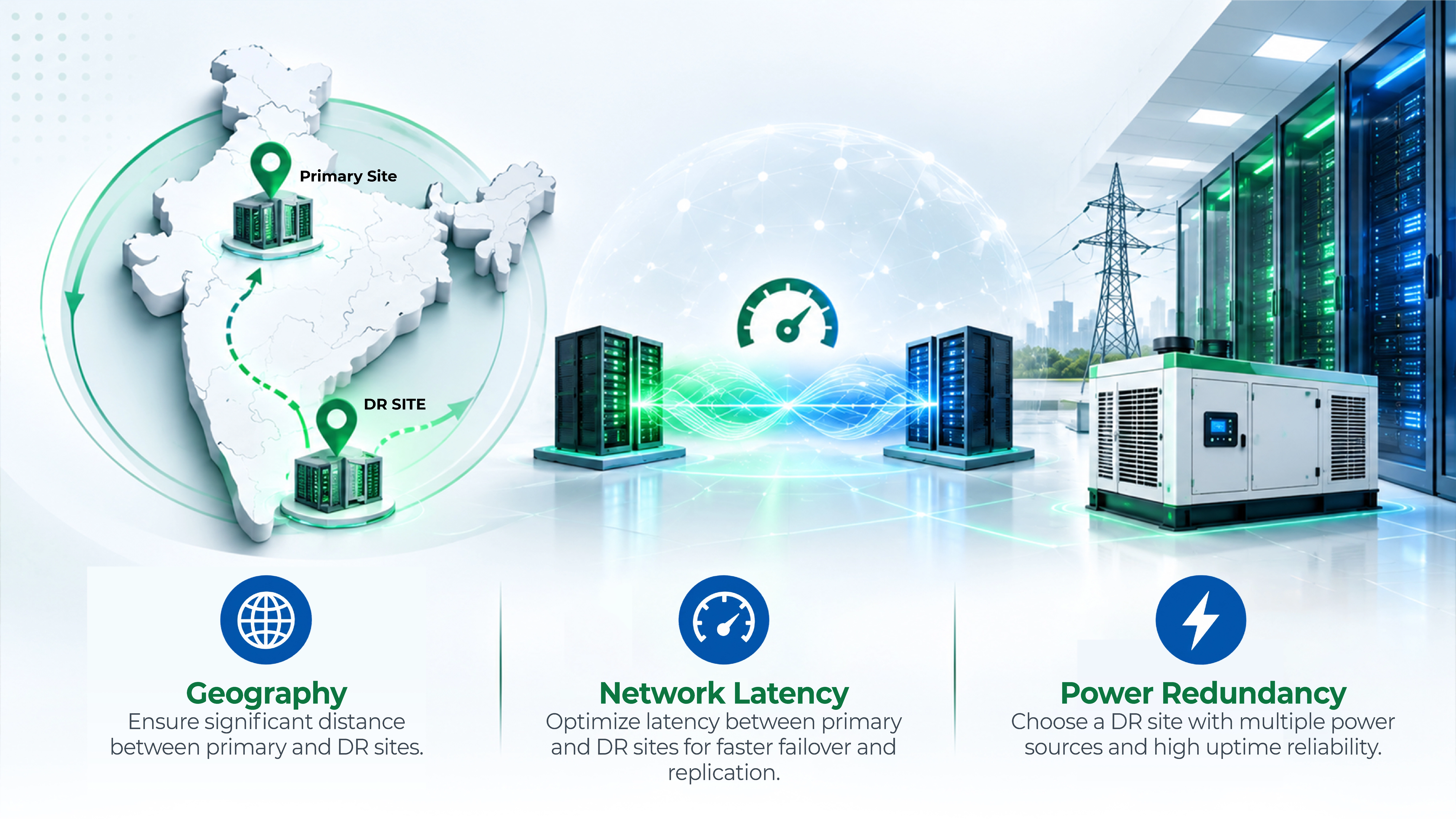
Geography determines survivability. A disaster recovery data center positioned in the same metropolitan area as your primary site is not a DR site. It's a warm spare that will go dark in the same regional event. This is one of the most common and costly mistakes made in DR planning across India.
The standard guidance calls for a minimum separation of 200–300 km between primary and DR facilities when the threat model includes regional disasters like cyclones, flooding, or seismic activity.
Network latency between the primary and DR sites also influences the replication strategy. Lower latency can support synchronous replication for workloads that require minimal data loss, while higher latency may make asynchronous replication a more practical choice. These considerations matter most when choosing between active-active and active-passive configurations.
Power redundancy at the DR site deserves equal weight as location. A disaster recovery data center must hold Tier III or Tier IV certification, with N+1 or 2N power architecture, on site diesel generators with extended autonomous runtime, and reliable utility power arrangements. A site that meets only two of those three criteria is a risk, not a solution.
RTO, RPO, and the Numbers That Drive Your DR Architecture
Recovery Time Objective and Recovery Point Objective are not aspirational targets. They are engineering constraints that determine what your DR infrastructure must physically be capable of doing.
An RTO of four hours means your DR site must be able to accept production traffic within four hours of a declared disaster. This includes failover, DNS propagation, and application validation. That's a specific set of infrastructure decisions such as choosing between warm standby and hot standby, pre provisioned compute and on demand spin up, and automated failover and manual runbook execution. Each choice carries a cost and a capability.
An RPO of fifteen minutes means your replication interval cannot exceed fifteen minutes. Your monitoring must detect replication lag before it crosses that threshold. Most organizations set RPO targets without instrumenting the replication pipeline to enforce them. That gap surfaces only during an actual recovery.
Be honest about the numbers your business needs vs. what your budget supports. An RPO of zero and an RTO of zero describes an active-active architecture, which is the most expensive approach and, for many workloads, genuinely unnecessary.
Most manufacturing, logistics, and mid-market SaaS operations can tolerate an RPO of 30–60 minutes and an RTO of two to four hours, which is achievable at a fraction of the cost.
How Slivernox Approaches Disaster Recovery Infrastructure
Slivernox operates carrier-neutral data centers in India designed specifically to support the replication and failover requirements of enterprise DR deployments. The facilities hold Tier III certification, with redundant power, multi-path cooling, and physical security compliant with ISO 27001 standards.
What distinguishes Slivernox's approach to disaster recovery data center deployments is the ecosystem they've built around connectivity. Carrier neutrality matters enormously in DR scenarios because it lets organizations bring in multiple diverse network paths from different providers and through different physical routes. This ensures that a carrier outage doesn't create a recovery bottleneck when you can least afford one. Most enterprise DR failures trace back to a single network dependency that wasn't visible until failover.
Slivernox also offers colocation for hybrid DR configurations, where organizations maintain physical servers for latency-sensitive workloads while routing cloud-eligible systems to an adjacent hyperscaler PoP. This architecture lets customers match workload requirements to infrastructure rather than forcing everything into a one-size model.
For IT managers evaluating DR sites, Slivernox provides facility tours, technical documentation on power architecture and SLAs, and access to engineering staff who can assess replication compatibility with your existing stack before you sign anything. That pre-sales rigor matters. A disaster recovery data center you haven't fully evaluated can become a liability instead of a solution.
What Most Organizations Get Wrong About DR Testing
DR testing is underfunded, under-scheduled, and frequently theatrical. Tabletop exercises help identify procedural gaps, but they don't validate that your replication is current, your runbooks are accurate, or that your team can restore services within the committed RTO.
A full failover test, where production traffic is genuinely routed to the DR site for a defined window, is the only test that proves your strategy works. Run it at least once a year. Run it at a time that's inconvenient, not a quiet Sunday morning, because disasters don't respect low-traffic windows.
Document every failure that surfaces during testing. Not to assign blame, but because each gap specifies what needs to change before the next test. Organizations that treat test failures as embarrassments rather than findings never build a reliable disaster recovery plan.
Test your people, not just your systems. The engineer who built the runbook may not be the person who executes it during an incident. Rotation matters.
If your organization is evaluating a disaster recovery data center in India and wants to work through the architecture, RTO/RPO requirements, and colocation options with engineers who've done this before, reach out to the Slivernox team directly. The initial conversation costs nothing and often surfaces assumptions that would otherwise surface at exactly the wrong moment.
Frequently Asked Questions
What is a disaster recovery data center?
A disaster recovery data center is a secondary facility that hosts replicated copies of an organization's critical systems, data, and applications so that operations can resume quickly after a failure at the primary site. It differs from a simple backup location because it's designed for live failover, not just data retrieval — it must be capable of running production workloads with minimal interruption.
How far should a DR data center be from the primary site in India?
The generally accepted minimum is 200–300 km of geographic separation. Shorter distances leave both sites vulnerable to the same regional events — cyclones, flooding, or grid instability — which defeats the purpose of geographic redundancy.
What is the difference between RTO and RPO in a disaster recovery plan?
RTO (Recovery Time Objective) is the maximum acceptable time for restoring services after a disaster — essentially, how long your business can be down. RPO (Recovery Point Objective) is the maximum acceptable data loss measured in time — how old the recovered data can be. Both must be defined before designing DR infrastructure, because they determine whether you need hot standby, warm standby, or asynchronous replication.
How often should an organization test its disaster recovery plan?
A full failover test should happen at minimum once a year, with quarterly tabletop reviews to validate procedural accuracy. Any major infrastructure change — a new application, a cloud migration, or a network topology change — should trigger an interim test or review, because DR plans that lag behind the production environment give false assurance when an actual event occurs.
What happens if a DR site is in the same city as the primary data center?
A co-located DR facility provides protection against localized events like a building fire or a hardware failure, but it offers no resilience against regional disasters. A city-wide power outage, a major flooding event, or a carrier failure affecting a metropolitan area will bring down both sites simultaneously. For genuine disaster recovery, geographic separation is non-negotiable.
Is cloud-based DR a replacement for a physical disaster recovery data center?
Not for all workloads. Cloud DR is cost-effective for systems where latency, regulatory requirements, and replication compatibility allow it. But latency-sensitive databases, licensed legacy software, and systems with complex on-premises dependencies often require physical colocation at a DR site. The most practical approach for most enterprises is a hybrid strategy: cloud DR for suitable workloads, physical DR colocation for everything else.
What certifications should a disaster recovery data center hold?
At minimum, look for Tier III or Tier IV certification from the Uptime Institute, ISO 27001 for information security management, and ISO 22301 for business continuity management. In India, relevant RBI or SEBI frameworks may also apply depending on your sector. Certifications are necessary but not sufficient — always validate the operational reality against the certificate.