
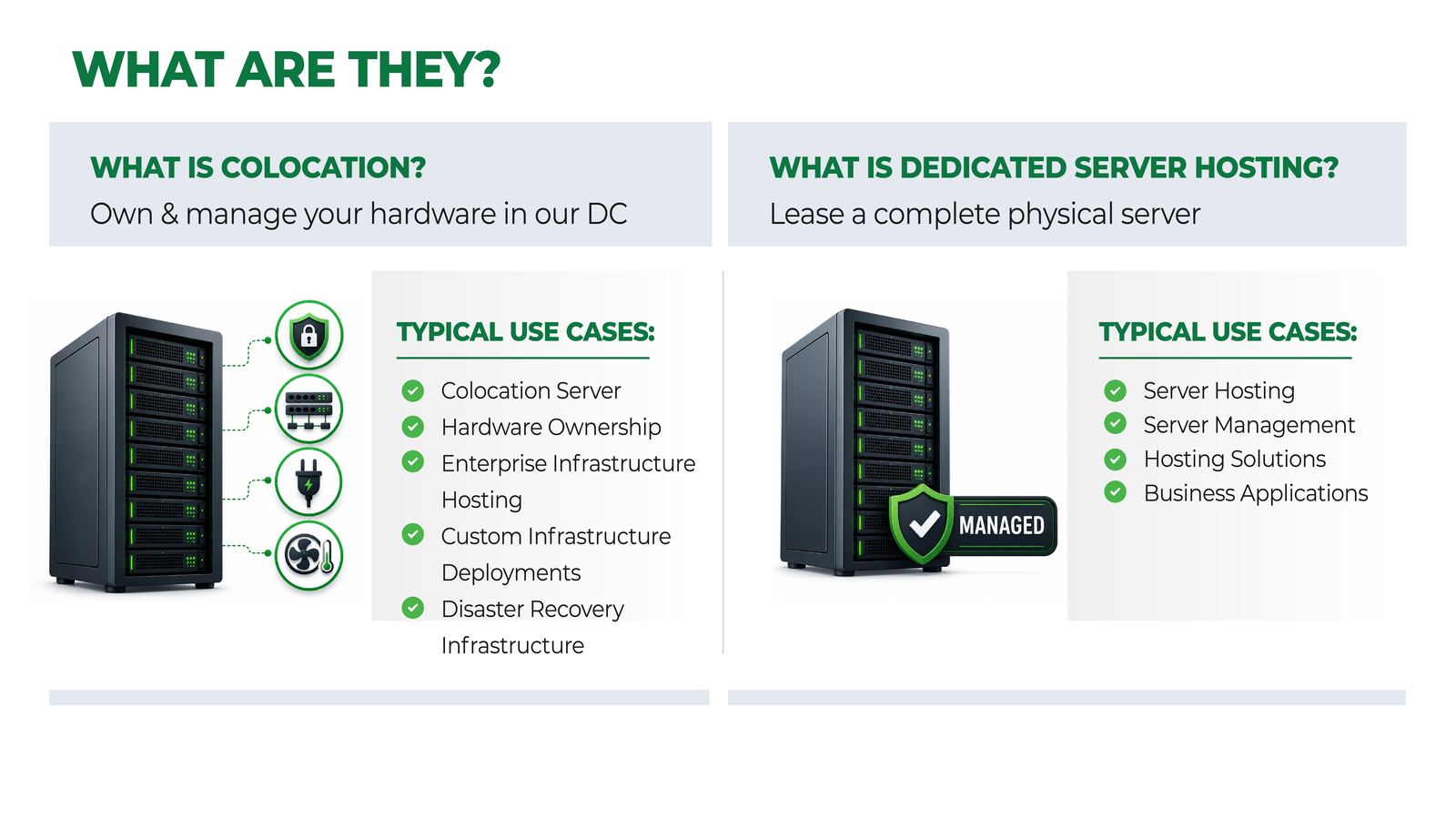
Modern enterprise IT leaders face a complex matrix of deployment options when architecting their infrastructure strategy. Among these options, choosing between colocation and dedicated server hosting remains a critical decision point for organizations aiming to optimize performance, control, and expenditure. While both models offer isolated, enterprise-grade hardware environments far removed from the security and resource-contention risks of multi-tenant public cloud environments, they represent fundamentally different approaches to asset ownership, operational responsibility, and financial management.
Selecting the wrong infrastructure model can introduce severe long-term friction, including unbudgeted capital expenditures, operational bottlenecks, compliance failures, or restrictive performance ceilings. To build an agile foundation, enterprise decision-makers must look past marketing definitions and evaluate how each deployment model maps directly to their workload profiles, regulatory mandates, internal engineering capabilities, and total cost of ownership (TCO) projections.
What is Colocation?
Colocation is a data center deployment model where an organization rents physical space such as racks, cabinets, cages, or private suites within a third-party commercial data center facility. Instead of building and maintaining a proprietary on-premises server room, the business leverages the massive industrial infrastructure of a specialized data center operator. The facility provides the foundational operational framework, including redundant power feeds, industrial cooling systems, physical security perimeter controls, and high-density carrier-neutral network connectivity.
In this arrangement, the enterprise retains absolute ownership and end-to-end management of the compute, storage, and networking hardware. The data center operator is solely responsible for maintaining the facility's uptime and environmental stability, leaving the tenant completely unconstrained in how they configure, patch, and utilize their physical equipment.
How Colocation Works
To deploy via a colocation model, a business procures its own enterprise servers, switches, firewalls, and storage arrays directly from hardware vendors. This equipment is then shipped to, unboxed within, and mounted inside the leased rack space at the data center provider's facility. The operator provisions the specified power drops (such as redundant A+B feeds), environmental controls, and network cross-connects directly to the client's cabinet, enabling the business's engineering team to configure their stack from the bare metal up.
Ownership Model
The ownership boundaries in a colocation model are completely clear-cut and capital-intensive. The customer owns 100% of the physical hardware assets, handles depreciation schedules, and manages vendor support contracts (such as Dell ProSupport or HPE Pointnext). The data center provider owns and manages the real estate, utility infrastructure, generators, cooling chillers, and building security systems, acting as an enterprise-grade landlord for your compute footprint.
Typical Business Use Cases
Colocation is the preferred option for mid-market and enterprise organizations operating legacy workloads that cannot be easily refactored for the cloud, as well as firms requiring highly specialized hardware architectures. It is heavily utilized by financial institutions running low-latency trading platforms, healthcare organizations securing massive electronic health record (EHR) repositories, and large SaaS providers looking to stabilize their base-load infrastructure expenses.
Advantages of Colocation
The primary advantage of colocation lies in total operational sovereignty and maximum architectural flexibility. Because your engineers select every internal hardware component, you can design highly optimized systems tailored precisely to your application profiles, such as selecting specific NVMe drives, FPGA accelerators, or custom RAM configurations. Furthermore, colocation facilities offer superior economies of scale regarding bulk power procurement, carrier-neutral network access, and physical compliance certifications that would be cost-prohibitive to build independently.
Limitations of Colocation
The main limitation of colocation is the substantial upfront capital expenditure (CapEx) required to buy server and networking hardware, alongside the logistical burden of deployment. Organizations must also maintain an internal engineering team or contract local field technicians to perform physical hardware troubleshooting, component replacements, and lifecycle upgrades.
When establishing infrastructure via server colocation in India or other rapidly developing tech hubs, companies must also carefully navigate localized data sovereignty laws and power grid reliability. This makes selecting a premium tier-certified facility with robust redundant power systems absolutely vital to mitigating operational risks.
What is Dedicated Server Hosting?
Dedicated server hosting is a service delivery model where a business leases an entire, isolated physical server and its associated network infrastructure from a service provider on a predictable subscription basis. Unlike public cloud environments where virtual instances share hypervisor resources, a dedicated server guarantees that 100% of the underlying bare-metal processing power, memory, and disk I/O are assigned exclusively to a single tenant.
This model eliminates the "noisy neighbor" effect entirely, ensuring highly predictable performance. However, because the provider owns, hosts, and maintains the physical server hardware within their own data center facilities, the customer avoids the burdens of hardware asset management, procurement lead times, and manual component maintenance.
How Dedicated Server Hosting Works
When a business provisions a dedicated server, they select a base hardware profile defining CPU cores, RAM volume, and storage capacity from the hosting provider's catalog. The provider automatically provisions the physical machine within their data center rack, connects it to their network core, and delivers a clean operating system installation (such as RHEL, Ubuntu, or Windows Server) with root access to the client. The client then configures applications and services remotely over an IP-KVM or SSH interface.
Ownership Model
Under the dedicated server hosting paradigm, the service provider retains absolute ownership of all physical assets, including the servers, storage systems, networking components, and the building itself. The customer owns zero hardware assets, instead purchasing an exclusive, non-shared right to utilize the hardware capacity. This shifts the infrastructure financial model completely from an up-front Capital Expenditure (CapEx) to a predictable, ongoing Operational Expenditure (OpEx).
Typical Business Use Cases
Dedicated servers are ideal for rapidly growing digital agencies, mid-sized e-commerce platforms experiencing heavy transactional volume, and software developers requiring isolated staging or production environments. It serves as a highly effective bridge for companies transitioning out of restrictive shared hosting or over-budget public cloud setups, allowing them to scale up performance without investing heavily in hardware engineering teams.
Advantages of Dedicated Servers
The most compelling benefit of dedicated hosting is operational velocity and convenience. Hardware can be provisioned and brought online in hours rather than the weeks or months required to buy and ship physical assets. Additionally, hardware failures such as a blown power supply or a degraded hard drive are resolved entirely by the hosting provider's on-site technicians at no extra expense to the client, backed by comprehensive hardware replacement Service Level Agreements (SLAs).
Limitations of Dedicated Servers
The primary limitation is constrained architectural flexibility and a higher long-term premium on a per-unit basis compared to owning hardware. Because you are choosing from a pre-defined hardware menu, you cannot easily implement custom motherboard configurations, legacy proprietary expansion cards, or highly specific storage fabrics.
As businesses look to scale their enterprise server hosting footprints across multiple regions, these monthly subscription margins can eventually compound into a total cost that outpaces the long-term amortization of buying your own hardware.
Key Differences Between Colocation and Dedicated Servers
Understanding the operational boundaries between these two hosting models requires a granular evaluation of where the provider's responsibilities end and your team's duties begin. While both deliver single-tenant performance insulation, they diverge across every core operational and financial vector.
| Criteria | Colocation | Dedicated Server |
|---|---|---|
| Hardware Ownership | The customer owns all physical servers and networking gear. | The provider owns all physical hardware and assets. |
| Upfront Investment | High CapEx (hardware procurement, shipping, rails). | Minimal to zero CapEx; initial month setup fee only. |
| Monthly Costs | OpEx for space, power consumption, and cross-connects. | All-inclusive predictable monthly OpEx lease fee. |
| Customization | Unlimited; choose any brand, component, or ASIC. | Limited to provider's supported hardware catalog configurations. |
| Performance Control | Total control over BIOS, firmware, OS, and topology. | High control over OS/Software; limited firmware control. |
| Scalability | Manual; bounded by rack space and hardware buy cycles. | Rapid; requested via portal or account rep provisioning. |
| Security Control | Full physical and logical governance over the stack. | Total logical control; physical security managed by the provider. |
| Compliance Readiness | Excellent for custom physical controls and audits. | Reliant on provider's certifications and infrastructure. |
| Operational Responsibility | Customer manages hardware fixes; provider handles facility. | Provider manages all hardware fixes and parts replacement. |
| Disaster Recovery Options | Highly customizable secondary site or SAN replications. | Dependent on provider backup services or software setups. |
| Long-Term Flexibility | Extremely high; assets can be repurposed or moved. | Low; bound to provider environment and network. |
The fundamental point of divergence centers on operational abstraction. Colocation demands that your enterprise possesses the maturity to manage physical technology assets throughout their lifecycles. If a drive fails in a colocation rack, your team must diagnose the amber light, ship a replacement component to the facility, and either dispatch an internal engineer or pay for "Remote Hands" service fees to perform the physical hot-swap.
In contrast, dedicated server hosting abstracts away the hardware layer entirely. A drive failure triggers an alert directly to the provider's internal NOC, and an on-site technician replaces the drive under their hardware SLA. This occurs without your team ever needing to track down a part number or touch a screwdriver.
Cost Comparison: Colocation vs Dedicated Server
A disciplined financial assessment of colocation versus dedicated hosting requires analyzing the shift between Capital Expenditures (CapEx) and Operational Expenditures (OpEx) across a multi-year horizon. Organizations must evaluate not only the immediate line-item setup charges but also the broader Total Cost of Ownership (TCO), which includes hardware depreciation, engineering hours, and lifecycle replacement cycles.
| Cost Element | Colocation | Dedicated Server |
|---|---|---|
| Initial Setup Costs | High (Server procurement, switches, racking kits). | Low (Standard provision or nominal configuration fee). |
| Hardware Refresh Costs | High recurring CapEx every 3–5 years. | Zero (Provider upgrades hardware or provisions new nodes). |
| Monthly Fees | Variable based on space (U count/racks) + metered power. | Fixed or predictable monthly subscription per server. |
| Upgrade Costs | Cost of buying components + shipping/labor. | Shift to a higher monthly tier or add-on charge. |
| Support Costs | Internal IT salaries or facility Remote Hands fees. | Included in monthly fee for all hardware-level issues. |
| Long-Term TCO (3–5 Years) | Often lower per unit for high-density, scaled deployments. | Higher total cost at massive scale due to rental premiums. |
Short-Term Costs
In a short-term evaluation window (12 to 18 months), dedicated server hosting is almost always the more cash-flow-friendly option. It eliminates the steep financial barrier of entry associated with purchasing high-end enterprise servers, which can easily cost thousands of dollars per node.
Businesses can preserve their capital for core product development or marketing initiatives, paying only a predictable monthly operational fee to get an enterprise-grade environment up and running instantly.
Long-Term Costs
When expanding the analytical view to a 3-year or 5-year timeline, the economic balance often tilts in favor of colocation for scaled deployments. Once the initial hardware acquisition costs are completely amortized, the ongoing monthly cost to maintain a colocation rack (paying for square footage, power allocations, and network circuits) is typically far lower than renting an equivalent volume of compute units from a dedicated hosting vendor.
The threshold where colocation becomes more cost-effective usually sits around 3 to 5 full, high-density server cabinets.
Cost Predictability
Dedicated server hosting offers superior short-term cost predictability because network bandwidth, chassis rental, and hardware maintenance are rolled into a single line item.
Colocation billing requires careful oversight; variations in power utilization (especially if billing is based on metered usage rather than a flat per-kilowatt allotment), unmanaged cross-connect fees, and variable Remote Hands engineering invoices can introduce month-to-month budget volatility if not monitored properly.
Security Comparison
For enterprises operating within highly regulated environments, infrastructure security cannot be treated as a secondary metric. Both models offer vastly superior isolation compared to multi-tenant public cloud setups where hypervisor vulnerabilities could theoretically lead to cross-tenant data leaks. However, the models split significantly regarding physical access governance and audit validation paths.
| Security Vector | Colocation Model | Dedicated Server Model |
|---|---|---|
| Physical Security | Multi-tier perimeters, biometric access, custom rack locks. | Managed entirely by the provider; the customer has no physical access. |
| Access Control | You define exactly who can touch or look at the chassis. | Restrictive; you rely on provider staff for physical handling. |
| Data Sovereignty | Total; you control exact data placement on owned disks. | Controlled via contract and provider data center location. |
| Compliance | Directly audit your physical hardware and configuration. | Dependent on provider's compliance certifications. |
| Audit Readiness | High; physical assets can be inspected by compliance officers. | Relies on SOC 2/ISO reports provided by the host. |
| Network Security | Custom firewalls, intrusion prevention systems, and air-gaps. | Managed via your OS-level firewall and provider switches. |
| Custom Security Controls | Hardware tokens, custom HSMs, and physical port blocking. | Limited to logical controls and supported vendor add-ons. |
In a colocation deployment, security control extends to the physical layer. If your organization must comply with rigid regulatory frameworks like PCI-DSS, HIPAA, or strict financial localization mandates, colocation allows you to implement specialized physical controls. You can install biometric scanners directly onto your dedicated rack cages, use physical lock-boxes for hard drive transport, and deploy specialized Hardware Security Modules (HSMs) or tamper-evident chassis switches.
With dedicated server hosting, you are completely dependent on the provider's physical security measures. While top-tier providers maintain world-class data centers featuring round-the-clock guards, biometric entry locks, and continuous CCTV surveillance, your internal security team cannot physically inspect the asset or control which data center employees handle the server during hardware maintenance.
Logically, however, both options give you full root-level software control, letting you deploy advanced encryption, zero-trust network configurations, and host-based intrusion detection systems.
Performance and Scalability Comparison
Evaluating infrastructure performance requires looking at raw compute output alongside how quickly the architecture can adapt to sudden, massive shifts in workload demand. While both environments excel at processing heavy IOPS and sustaining compute-heavy workloads, their approach to scaling resources represents a fundamental trade-off between customization depth and operational speed.
Resource Availability
Dedicated servers grant immediate access to fixed, highly reliable pools of bare-metal resources. Because there is no hypervisor layer abstraction slowing down communication between the operating system and the silicon, applications benefit from ultra-low latency and consistent processing power.
Colocation takes resource optimization a step further, enabling your teams to design specialized, high-performance environments such as configuring high-density GPU nodes for AI inference or optimizing storage arrays for massive databases without being restricted by a hosting provider's standard component availability.
Hardware Customization
Colocation is the undisputed leader in hardware customization. When you own the bare metal, your engineering architects can customize every detail of the machine's anatomy.
You can mix and match components from specialized vendors, deploy customized liquid cooling loops for overclocked chips, or install proprietary network interface cards (NICs) tuned for specific low-latency network protocols. Dedicated server hosting constrains your architecture to standardized configurations, which may require compromising on specific motherboard chipsets or specialized hardware optimizations.
Growth Flexibility
When it comes to speed of scaling, dedicated hosting holds a significant advantage. If an enterprise needs to deploy ten additional web servers to handle an unexpected seasonal surge in user traffic, a dedicated hosting provider can often provision those nodes within their existing racks almost instantly.
Scaling a colocation footprint requires a much longer runway: you must create hardware purchase orders, wait out manufacturing and supply chain shipping windows, physically rack and cable the new machines, and provision additional power drops with the data center operator.
Performance Consistency
Both models offer exceptional performance consistency because they eradicate the resource theft common in shared virtual environments.
The decision here depends on where your performance bottlenecks lie: if your applications require standard, high-performance computing power, dedicated servers deliver this instantly. If your workloads demand unconventional, fine-tuned hardware architectures to achieve peak efficiency, colocation provides the unrestricted canvas needed to build those systems.
Which Businesses Should Choose Colocation?
Colocation is not an all-in-one remedy for every corporate workload; rather, it is a highly strategic solution tailored for enterprises that view infrastructure control as a core competitive advantage. This approach is highly effective for organizations managing large, predictable, data-heavy workloads where shifting fully to public cloud or rental models would introduce prohibitive bandwidth fees and unpredictable monthly billing.
A classic example is a mid-sized healthcare enterprise managing extensive patient diagnostic imaging archives. Due to strict health data regulations and massive file sizes, streaming this data out of a public cloud can lead to high network egress costs. By utilizing colocation, the hospital can install high-capacity, custom SAN arrays within a secure facility, ensuring full compliance with data privacy mandates while keeping data access speeds high and network costs predictable.
Similarly, financial brokerages running complex algorithmic trading applications rely on colocation to place their proprietary, low-latency servers within the same data centers as financial exchanges, shaving off crucial milliseconds that would be lost over standard rental connections.
Which Businesses Should Choose Dedicated Servers?
Dedicated server hosting is the ideal choice for agile enterprises that want single-tenant performance and data isolation but want to avoid the logistical complexities of hardware supply chains, data center real estate management, and physical maintenance. It fits organizations that prioritize operational velocity, flat-rate predictable scaling, and minimal initial capital investments.
Consider a rapidly scaling e-commerce platform gearing up for a major global product launch. The development team needs single-tenant bare-metal environments to process high-volume database transactions without any slowdowns, but they cannot wait weeks to buy and configure physical servers. Opting for dedicated server hosting allows them to spin up pre-configured, high-performance servers in just a few clicks.
This model is also highly valuable for digital agencies managing software ecosystems for multiple corporate clients. It gives them the ability to host client workloads on dedicated, high-performance systems while keeping monthly costs predictable and leaving all hardware repairs and physical drive swaps to the hosting provider.
Decision Framework: How to Choose the Right Option
To cut through the technical noise, enterprise stakeholders can utilize this structured decision matrix to guide their infrastructure selection based on current operational realities and three-to-five-year growth projections.
| If Your Business Position Is... | Your Best Architecture Choice Is... |
|---|---|
| You have a CapEx budget available, own legacy server hardware, and employ network engineers. | Colocation |
| You want to launch within 48 hours, convert infrastructure costs entirely to OpEx, and avoid hardware lifecycle management. | Dedicated Server Hosting |
| You are bound by strict compliance frameworks requiring custom physical security, dedicated cages, and hardware-level audit trails. | Colocation |
| You run standard Linux/Windows application stacks with lean IT staff and need guaranteed hardware uptime SLAs. | Dedicated Server Hosting |
Common Mistakes Businesses Make When Comparing Hosting Models
When evaluating infrastructure transitions, procurement teams and IT managers often fall into standard analysis traps that cloud the true cost and efficiency of their deployments.
1. Focusing Exclusively on Monthly Rental Fees
Looking only at the base monthly cost of a dedicated server versus a colocation rack footprint leads to incomplete cost comparisons. A comprehensive evaluation must include network cross-connect fees, power allocation limits, data egress rates, and the internal labor costs required to manage the systems over time.
2. Ignoring Hardware Lifecycle and Refresh Expenses
Server hardware has a reliable operational lifespan of roughly 3 to 5 years before maintenance costs and failure rates climb. Companies choosing colocation must budget for future capital injections to replace aging nodes, whereas dedicated hosting users offload that financial lifecycle management completely onto the service provider.
3. Underestimating Compliance and Audit Verification Needs
Assuming a hosting provider's basic data center compliance automatically covers your specific regulatory obligations can lead to issues during audits. If your industry requires verifying physical custody of data drives or running custom hardware security modules, a standard dedicated server may fail an audit that a tailored colocation environment would pass easily.
4. Overlooking Future Scalability Runways
Selecting colocation without factoring in long-term expansion space can leave you boxed in. If a data center facility reaches maximum capacity, expanding your footprint might require a costly and logistically complex migration to an entirely new room or facility.
Conclusion
Choosing between colocation and dedicated server hosting is not a matter of finding the objectively superior technology; rather, it is about aligning your infrastructure choices with your organizational capabilities, financial preferences, and regulatory demands.
Colocation provides unmatched long-term flexibility, total asset control, and deep hardware customization, making it the bedrock choice for enterprises with established infrastructure engineering teams and specific architectural demands. Dedicated server hosting offers incredible speed to market, operational simplicity, and a predictable OpEx financial structure, making it ideal for fast-growing companies that want to offload the complexities of physical hardware management.
As you plan your next infrastructure step, having a trusted partner makes all the difference. At Silvernox, we understand that enterprise infrastructure requires tailored solutions, not one-size-fits-all templates. Whether your strategy points toward the deep control of premium Colocation Services or the agile, turnkey power of enterprise-grade Dedicated Server Hosting, our modern facilities and engineering teams are ready to help.
Connect with a Silvernox infrastructure architect today to review your workload profiles, map out a clear cost-benefit breakdown, and build a high-performance foundation designed for your long-term growth.
Frequently Asked Questions
Is colocation cheaper than a dedicated server?
It depends on scale and time horizon. Dedicated servers usually cost less upfront, while colocation often becomes more cost-effective over the long term once hardware costs are amortized over 3–5 years. For smaller deployments (under 3–5 servers), dedicated hosting wins on total cost because you avoid buying hardware outright. Once you cross that threshold and hardware costs are fully amortized, running your own equipment in a colocation facility typically costs significantly less per unit than renting equivalent capacity month to month. The key variable is whether you have the engineering staff to manage physical hardware — if not, the labor savings from dedicated hosting can offset the rental premium.
What is the main difference between colocation and dedicated servers?
The core difference is hardware ownership: with colocation, you own the servers; with dedicated hosting, the provider owns them and rents you exclusive access. In colocation, your team purchases, ships, and manages the physical machines — the data center simply provides the space, power, cooling, and network connectivity. In dedicated server hosting, the provider owns everything physical and handles all hardware maintenance, while you get full remote control over the OS and software.
Which option offers better security?
Both offer strong single-tenant isolation, but colocation gives you more physical security control — dedicated servers rely on the provider's physical practices. With colocation, your team decides exactly who can access the hardware, what physical locks are installed on your rack cage, and which custom security modules (like HSMs) are deployed. With dedicated servers, the provider manages all physical access, and you're trusting their staff and procedures. Both options give you full root-level logical control to deploy encryption, firewalls, and intrusion detection.
Is colocation suitable for small businesses?
Generally no — colocation only makes sense for small businesses if they already own specialized hardware or have very specific compliance needs. The upfront cost of purchasing enterprise servers, arranging shipping to a data center, and managing hardware over time usually doesn't pay off at small scale. Most small businesses are better served by dedicated server hosting or managed cloud.
Can colocation and cloud environments be used together?
Yes, this hybrid model is highly popular among mid-market and enterprise organizations. Businesses frequently colocate their core database systems and heavy, predictable workloads within a physical data center cabinet while using public cloud connections for flexible application front-ends or temporary development environments.
Which model provides better performance?
Both models offer outstanding, stable performance because they run on dedicated bare metal without the overhead of shared hypervisors. Colocation has a slight edge for unconventional workloads because your team can select and tune every internal component such as high-speed NVMe drives or specialized acceleration cards to match your exact software needs.
How many servers do I need before colocation makes financial sense?
Most infrastructure analysts put the crossover point at 3 to 5 fully loaded server cabinets, or roughly 10–15 physical servers at enterprise spec. Below that threshold, the cost of buying hardware, shipping it, and paying for remote hands services when something breaks typically exceeds what you'd pay to rent equivalent dedicated servers monthly.
Is a dedicated server the same as a bare metal server?
They are effectively the same thing. "Bare metal server" is just a more technical term for a dedicated physical server with no hypervisor layer. Both refer to a single-tenant physical machine where no virtualization is involved, giving you direct access to all hardware resources.