
Walk into almost any mid-market enterprise office, and there is a decent chance you will find a legacy server room running out of a modified back closet or a dedicated corner of the IT floor. Historically, keeping your hardware within arm's reach felt reassuring. It gave infrastructure teams a sense of absolute control, immediate physical oversight, and instant accessibility.
But that old-school sense of control has slowly morphed into a major operational liability.
The digital demands hitting businesses now have fundamentally broken the on-premise model. Between massive, unpredictable data workloads, persistent security threats, complex compliance mandates, and zero-tolerance uptime expectations, managing infrastructure internally is a bruising battle. It forces your technology leadership into a frustrating split focus: trying to build great digital products while simultaneously acting as real estate managers, electrical specialists, and cooling mechanics.
The physical reality of modern computing — the sheer power draw, the intensive heat generation, and the constant audit requirements — is exhausting internal budgets and engineering teams alike.
That strain is exactly why forward-thinking CIOs and financial leaders are systematically moving their critical production hardware out of office closets and into professional colocation data center services. It is a strategic pivot. You get access to industrial-grade infrastructure, multi-layered utility redundancy, and built-in compliance frameworks, all without taking on the crushing capital expense of building or operating your own facility.
What Is Colocation Hosting?
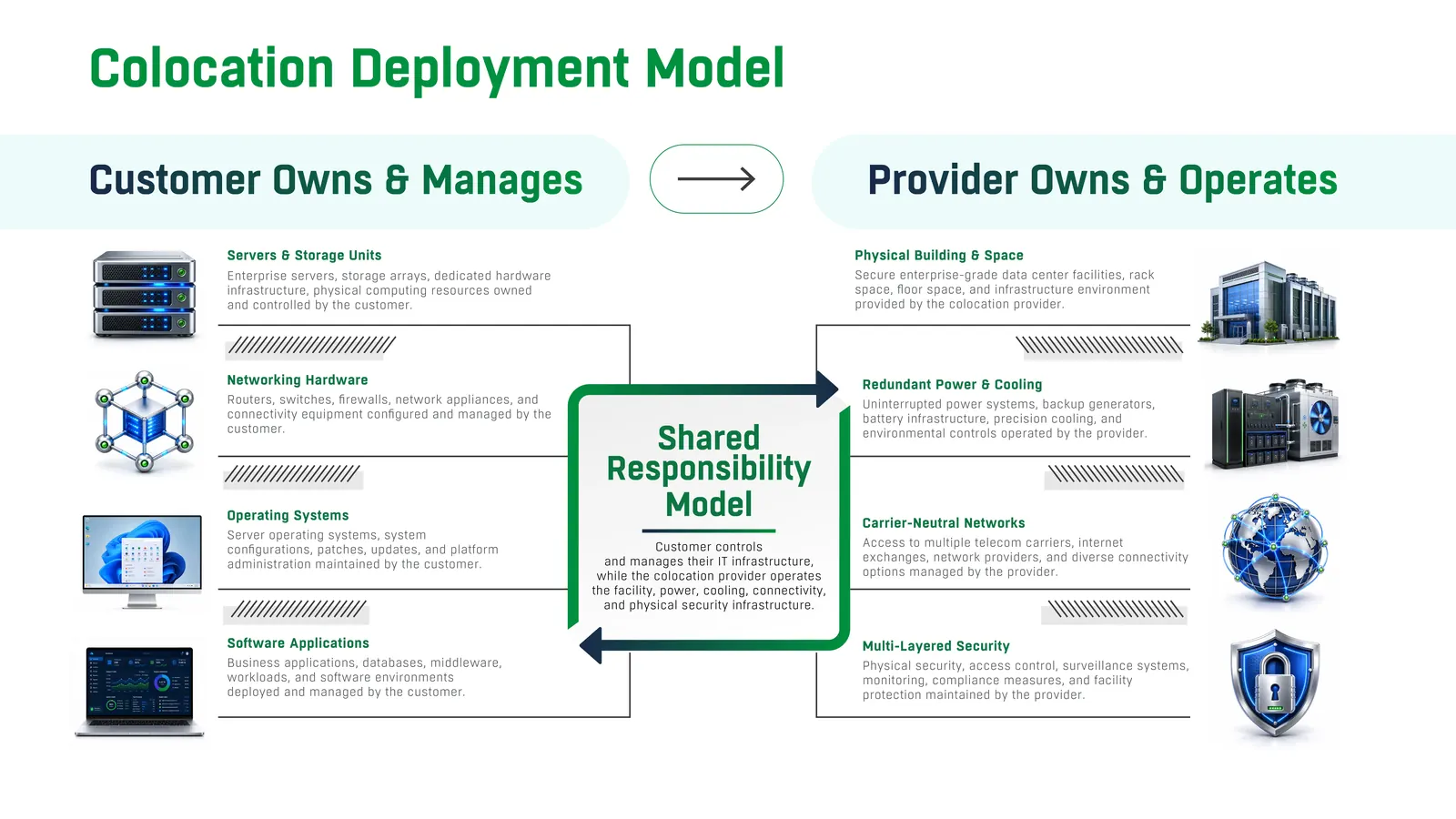
Strip away the industry jargon, and colocation hosting is a straightforward infrastructure strategy: your organization buys and retains complete asset ownership of your servers, storage arrays, and switches, but you place that hardware inside a specialized, highly resilient commercial data center. You are essentially leasing high-performance floor space, power, cooling, and network links.
To see where this fits strategically, it helps to look at how it differs from other infrastructure choices:
- Colocation vs. In-House: In-house means you own the entire operational headache. If the building's roof leaks over the server rack, or the backup generator batteries fail during a local blackout, that is your financial and operational disaster to fix. Colocation offloads that environmental liability entirely, while ensuring you retain 100% configuration authority over your bare-metal hardware.
- Colocation vs. Public Cloud: The cloud abstracts everything away, giving you virtualized slices of multi-tenant infrastructure. It offers agility, but can expose you to variable performance from "noisy neighbors" and volatile, unpredictable data egress bills. Colocation lets you maintain dedicated, predictable hardware assets crucial for heavy steady-state workloads or strict security policies that demand total data isolation.
- Colocation vs. Managed Hosting: With managed hosting, the provider leases you their physical hardware and handles basic operating system administration. Colocation keeps the hardware assets firmly on your balance sheet, giving your architecture team total freedom to build custom environments.
Most companies scale into this model when their workloads begin drawing more power than their office building can deliver, or when enterprise clients start demanding physical security certifications they simply cannot replicate in a standard commercial office space.
The Growing Challenges of Managing In-House Server Infrastructure
Operating an on-premise server room comes with a steep tail of hidden liabilities that rarely show up clearly on an initial IT budget overview.
The Capital Trap of Real Estate and Upgrades
Modern server hardware draws incredible power and generates concentrated thermal pockets. Traditional office building HVAC units and basic electrical distribution boards are not built to handle these environments. Upgrading an existing office space to stay ahead of this heat requires an immediate cash injection for industrial UPS systems, precision cooling loops, and dedicated diesel generators. That capital becomes locked in a rapidly depreciating, non-core physical asset.
Engineering Friction and Core Focus Distraction
When critical hardware lives down the hall, your highest-paid network engineers and systems architects spend their days distracted by building facilities issues. They find themselves managing air conditioning maintenance schedules, monitoring building power quality, or handling physical escort duties for vendor technicians. It is a massive drain on morale and efficiency, pulling focus away from high-value projects like application security, data strategy, and software delivery.
Structural Business Liabilities
Relying on a modified office server room introduces three undeniable operational risks to the broader enterprise:
- Unpredictable Downtime: Standard office utilities are vulnerable to local grid failures, routine building maintenance shutdowns, or localized electrical faults that can instantly drop your systems offline.
- Audit Blindspots: Office spaces are built for employee movement, making it incredibly difficult to enforce, let alone document, the strict access tracking required by modern cybersecurity insurers and regulatory bodies.
- Single-Point-of-Failure Disaster Risks: If your primary server stack sits in the exact same physical facility as your core business staff, you have built a massive operational dependency. A localized utility fire, structural break, or severe weather event at the office can paralyze your entire enterprise workflow simultaneously.
Top 10 Benefits of Colocation Hosting
1. Lower Infrastructure Costs
Building a dependable, redundant private server room demands huge upfront capital and saddles the business with unpredictable operational spikes for specialized maintenance and high commercial electricity rates. Data centers run on massive economies of scale, sharing the cost of heavy industrial cooling, high-capacity backup systems, and continuous facilities engineering across hundreds of enterprise tenants. This transforms a lumpy, volatile CapEx financial burden into a highly predictable, flat monthly OpEx structure.
2. Enterprise-Grade Physical Security
Corporate offices are designed to be accessible, leaving core physical assets exposed to accidental or intentional internal tampering. Professional facilities use an aggressive, multi-layered "defense-in-depth" security posture, requiring anti-tailgating mantraps, multi-factor biometric checks, and continuous video monitoring overseen 24/7/365 by on-site security professionals.
3. Higher Reliability and Uptime
Local commercial office grids are highly susceptible to brownouts and seasonal disruptions. Top-tier colocation facilities are built for concurrent maintainability, guaranteeing fully independent 2N electrical paths, automatic transfer switches, redundant industrial cooling loops, and immediate generator backup strings — all backed by contractually binding SLAs.
4. Better Scalability
Physical office spaces have hard structural ceilings. Data center environments are modular and built for rapid, elastic growth — expanding your footprint is as simple as requesting an additional rack position or a secure private cage without impacting your active production environment.
5. Improved Network Performance
In-house setups are restricted to whichever telecom providers happen to service that specific street address. Established data centers run as carrier-neutral connectivity hubs, with Meet-Me-Rooms featuring direct fiber entries from dozens of global Tier-1 networks and localized internet exchanges — giving your team leverage to negotiate competitive bandwidth pricing.
6. Reduced Operational Burden
Internal infrastructure talent is routinely dragged into managing facility upkeep. The data center provider owns and executes all building operations — generator testing, environmental tuning, mechanical maintenance, and perimeter security — freeing your engineering team to focus on strategic business initiatives.
7. Stronger Disaster Recovery Readiness
Operating your primary server rack inside your main corporate office building creates a highly vulnerable architecture. Moving your production footprint into a professional data center completely decouples your data from your corporate headquarters, hardening your business continuity plan against unexpected disasters.
8. Easier Compliance and Audit Preparation
Preparing an office server closet to pass modern regulatory security audits (ISO 27001, SOC 2 Type II, PCI-DSS) is a brutal, months-long process. Professional data centers maintain independent, third-party compliance certifications across all physical and environmental controls that your internal compliance teams can directly inherit.
9. Access to Better Infrastructure Ecosystems
Connecting on-premise hardware to external cloud resources requires expensive, long-haul telecom circuits. Top-tier colocation hubs contain dense interconnection ecosystems, allowing for direct, low-latency physical cross-connects and dedicated on-ramps to major public cloud environments — enabling high-performance hybrid infrastructure.
10. Future-Ready Infrastructure Strategy
Modern enterprise workloads like AI modeling and high-volume data analytics generate extreme localized heat and draw power levels office infrastructure cannot physically sustain. Industrial data centers are explicitly engineered for high-density computing, providing advanced power delivery and specialized airflow containment capable of sustaining 20+ kVA per rack safely.
Colocation vs. In-House Servers: Side-by-Side Comparison
| Operational Vector | In-House Server Room | Professional Colocation |
|---|---|---|
| Financial Structure | Lumpy, unpredictable CapEx for renovations, hardware refreshes, and maintenance. | Predictable, smooth OpEx with fixed, transparent monthly recurring fees for footprint and power. |
| Power & Cooling Redundancy | Usually single-path utility entries. Achieving real system redundancy requires massive layout. | Industrial-grade 2N or N+1 electrical and mechanical paths ensuring uptime during regional utility failure. |
| Physical Security Layer | Limited to standard office badges, consumer-grade door locks, and public reception areas. | Multi-layered defense-in-depth including biometric scans, mantraps, and 24/7/365 security personnel. |
| Scalability Pace | Highly constrained by physical office walls, base building power panels, and HVAC ceilings. | Rapid, modular expansion into adjacent rack positions or secure private cages as workload demands scale. |
| Network Pathing & Choice | Restricted to local street telco options, resulting in higher pricing and limited route diversity. | Highly dense, carrier-neutral Meet-Me-Rooms with access to multiple Tier-1 lines and cloud on-ramps. |
| Compliance Workload | Internal teams must manually build and document physical facility safety controls for auditors. | Inherited physical certifications (ISO 27001, SOC 2, HIPAA) directly compress your regulatory audit scope. |
| Operational Focus | Engineers spend valuable time troubleshooting facilities, HVAC technicians, and power glitches. | Facilities are fully managed by the provider; infrastructure talent focuses on software and core architecture. |
| Disaster Recovery Position | Fragile approach; critical production data is physically tied to the corporate office building. | Geographically decoupled; core business systems stay live and performant through local office emergencies. |
When Should Businesses Choose Colocation?
Migrating your infrastructure into a data center is a strategic transition typically driven by specific operational milestones. Your organization should evaluate a colocation shift if you are navigating any of the following scenarios:
- Approaching Facility Thresholds: Your office electrical configuration is nearing its maximum safe load, or your cooling units are struggling to keep rack temperatures stable during warmer seasonal cycles.
- Escalating Uptime Demands: The business is launching mission-critical, customer-facing digital services, APIs, or transactions where even brief periods of downtime cause immediate financial hit or customer churn.
- Facing Rigorous Regulatory Audits: Your business is entering highly regulated enterprise spaces (finance, fintech, healthcare) that demand documented, audited physical access logs and absolute data isolation.
- Building a Hybrid Network Strategy: Your systems require keeping massive, predictable data stores on dedicated hardware for cost efficiency, while needing ultra-low-latency hooks into public clouds for variable compute bursting.
Common Misconceptions About Colocation Hosting
"Colocation is only cost-effective for large enterprise entities" — Many mid-market companies assume data centers only negotiate with buyers looking for massive private data halls. In reality, colocation services are highly modular; growing infrastructure teams can start with a single rack position and gain access to top-tier reliability.
"The public cloud makes colocation obsolete" — Running massive, steady-state enterprise applications in the cloud full-time can lead to eye-watering monthly bills and unpredictable data egress fees. Colocation offers the perfect middle ground.
"Colocation is too expensive compared to running things on-premise" — Teams often overlook hidden overhead like infrastructure maintenance contracts, building insurance premiums, and the direct cost of business downtime when comparing on-premise costs.
"Managing hardware remotely introduces too many difficulties" — Modern data center deployments provide comprehensive management portals with real-time visibility, plus on-site Smart Hands services for routine physical tasks around the clock.
Conclusion
Choosing between maintaining an on-premise server closet or migrating to a data center is a fundamental decision that determines the speed, resilience, and security of your entire digital operation. Colocation allows your enterprise to step up to professional power redundancy, low-latency network diversity, and audited physical safety parameters, all while keeping complete ownership of your critical hardware assets.
At Silvernox, we provide the enterprise-grade colocation environment that modern businesses demand. Our carrier-neutral Data Center Services are engineered with the resilient power, precise cooling, and multi-layered security required to keep your critical infrastructure safe and scalable. Partner with Silvernox to move past the limits of on-premise hosting and build a secure, resilient foundation for your digital future.