If your business runs on infrastructure that can't afford to go dark, you need to understand uptime standards, not as a nice-to-have, but as the thing every hosting or colocation decision actually depends on.
The Uptime Institute's Tier Classification system gives IT leaders a shared vocabulary for talking about reliability and risk before a contract gets signed. Whether you're a CTO sizing up disaster recovery options or an IT manager negotiating over an SLA, knowing what each tier actually means in practice will save you from costly surprises.
What Is the Uptime Institute Tier System?
The Uptime Institute developed its Tier Classification system to create a standardized, vendor-neutral benchmark for evaluating data center infrastructure. Each tier defines a specific level of redundancy, fault tolerance, and expected annual downtime, giving buyers a reliable way to compare facilities across different vendors and geographies.
The system uses four tiers, numbered I through IV. Higher numbers mean greater redundancy, more concurrent maintainability, and less tolerated downtime. But the tiers are not simply steps on a ladder. The jump from Tier 2 to Tier 3 represents a fundamental shift in how the facility is designed, not just an incremental improvement.
The Uptime Institute grants certification after a rigorous documentation and site audit process. A facility claiming to be "Tier 3 equivalent" without certification is making a marketing claim, not a verified engineering statement. That distinction matters when you are making infrastructure commitments that will affect your business for three to five years.
Data Center Uptime Standards: Tier 1 and Tier 2 Explained
Most enterprise IT leaders will never seriously look at a Tier 1 facility, but understanding the baseline clarifies why the upper tiers command premium pricing.
Tier 1: Basic Site Infrastructure
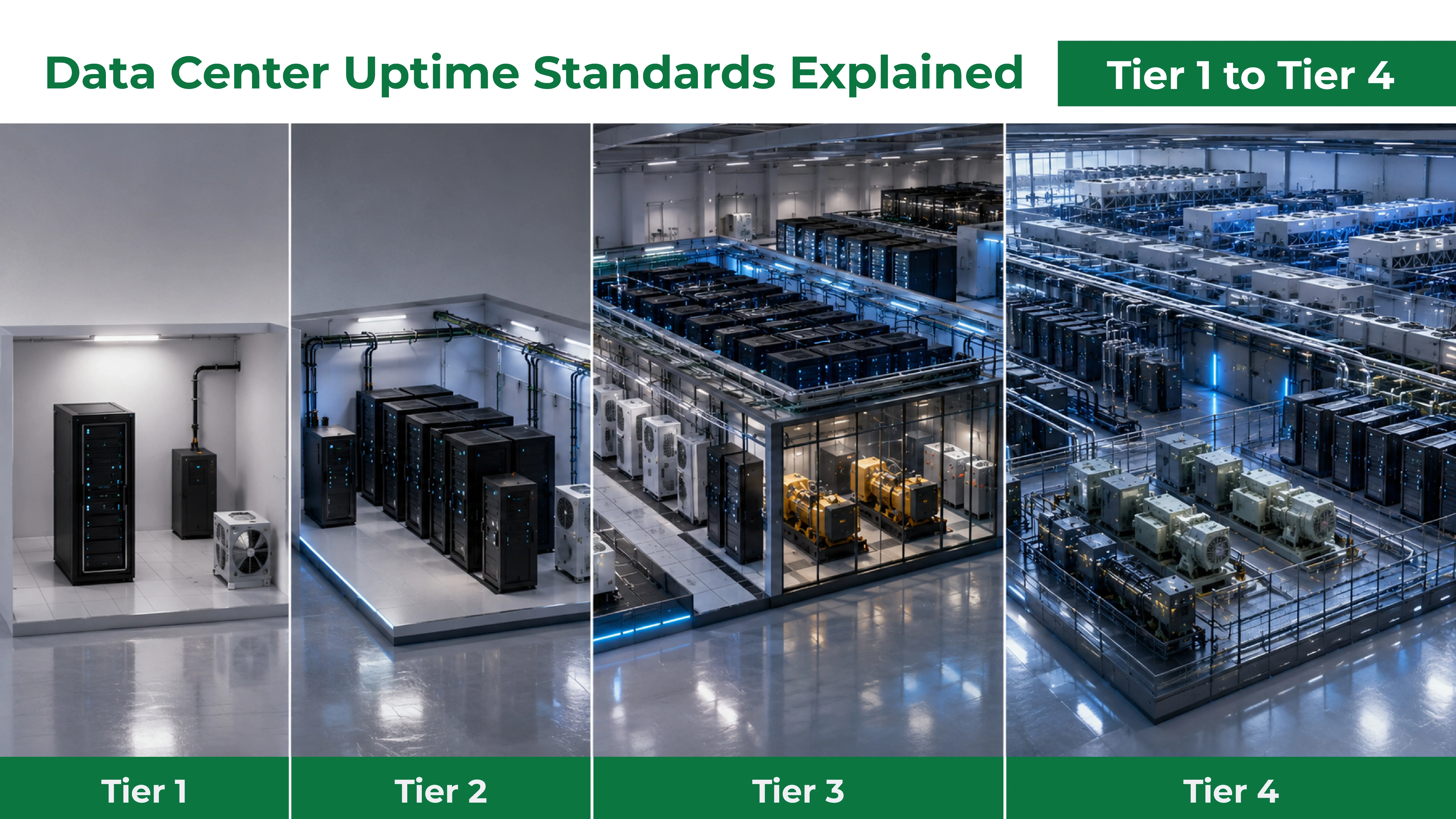
Tier 1 is the starting point. It includes a single, non-redundant distribution path for power and cooling, with no backup components beyond a basic UPS and generator. Expected annual downtime is approximately 28.8 hours, which translates to roughly 99.671% availability. Planned and unplanned maintenance requires a full shutdown.
For small businesses or non-critical internal workloads, Tier 1 may be acceptable. But for any system where downtime has a measurable revenue impact, it is the wrong choice.
Tier 2: Redundant Site Infrastructure Capacity Components
Tier 2 adds redundant capacity components such as extra UPS modules, chillers, and generators, but still routes power and cooling through a single path. Annual downtime allowance drops to approximately 22 hours, or about 99.749% availability.
The practical limitation is any maintenance on that single distribution path still requires downtime. You have backup equipment standing by, but no way to reroute around the path you need to service. For organizations running business-critical applications, that constraint is a meaningful operational risk.
Data Center Uptime Standards: Tier 3 and Tier 4 Explained
This is where things start to line up with what most modern enterprise workloads actually need.
Tier 3: Concurrently Maintainable
Tier 3 is the dominant standard for serious enterprise colocation. It includes multiple independent distribution paths for power and cooling, with enough redundancy that any single component can be taken offline for maintenance without interrupting operations. Annual downtime allowance is approximately 1.6 hours, or 99.982% availability.
The word "concurrently" is the key here. You can repair, replace, or upgrade infrastructure while the facility remains live. This is not a luxury for businesses with 24/7 uptime requirements; it is the minimum viable architecture.
Tier 3 needs at least N+1 redundancy, meaning one backup component for every active component in the critical path. Most reputable data center services in India operate at this tier for enterprise-grade colocation offerings.
Tier 4: Fault Tolerant Site Infrastructure
Tier 4 is the gold standard. Every system has 2N redundancy, with two complete, independent infrastructure paths, so that any single failure, whether a component fault or a human error during maintenance, does not affect uptime. The annual downtime allowance is approximately 0.4 hours, or 99.995% availability.
The engineering cost of Tier 4 is substantial. Construction and operational expenses can run significantly higher than a comparable Tier 3 facility. So while the uptime improvement sounds modest on paper, the architectural complexity and the assurance it provides are in a different category entirely.
Tier 4 makes sense for banks, healthcare platforms, government infrastructure, and any organization where a few minutes of downtime triggers regulatory or reputational consequences. For most other businesses, Tier 3 delivers what they actually need without the extra cost.
Why the Tier Gap Matters More Than Most People Admit
Procurement teams often treat the Tier rating as a checkbox. It is not. The difference between Tier 2 and Tier 3 is not a marginal reliability improvement. It is the difference between a facility that requires scheduled outages and one that does not.
Let's take a scenario: your colocation provider needs to replace a failing cooling unit. In a Tier 2 facility, that work must be scheduled during a maintenance window, which means your team coordinates a planned outage, migrates or powers down workloads, and accepts business disruption. In a Tier 3 facility, the same work happens transparently, and you likely receive nothing more than a courtesy notification.
And here is where it gets nuanced. A Tier 3 certification covers the infrastructure design, not operational behaviour. A well-run Tier 3 facility with disciplined change management will outperform a poorly managed Tier 4 facility in real-world reliability. Certification is necessary but not sufficient; operating procedures and staff training matter just as much.
Choosing the Right Tier for Your Business
The right Tier depends on what downtime costs you, not just financially, but operationally and reputationally.
A useful way to frame the decision is to estimate the hourly cost of a full infrastructure outage. Include direct revenue loss, staff idle time, customer-facing SLA penalties, and brand impact. If that number exceeds the annual cost premium of a higher-tier facility, the upgrade pays for itself.
For most Indian enterprises running ERP systems, customer-facing applications, or cloud workloads, Tier 3 is the right answer. It delivers the concurrent maintainability that prevents unplanned downtime while keeping costs manageable. Tier 4 is worth evaluating if you operate in a regulated industry where even brief outages carry compliance risk.
One thing experienced consultants will tell you is this: never over-specify for vanity. A small company paying Tier 4 rates for a workload that would survive a two-hour outage is wasting capital that could fund better application architecture or disaster recovery planning.
Data Center Services in India: What to Look For
India's data center market has grown significantly over the past decade, driven by digital transformation across the banking, e-commerce, healthcare, and manufacturing sectors. When evaluating data center services in India, Tier certification is the starting point, but it's far from the whole picture.
Geographic redundancy matters. A facility located in a region with lower seismic or flood risk has a structural advantage that no Tier rating can fully compensate for. Power reliability at the grid level also varies considerably from city to city in India, making on-site generator capacity and fuel logistics important factors to evaluate.
Connectivity is equally important. Look for facilities with multiple upstream ISPs, diverse fibre entry points, and proximity to major Internet Exchange Points (IXPs). A Tier 3 facility with a single upstream carrier introduces a reliability risk that exists entirely outside the scope of the Uptime Institute's Tier certification.
For regulated industries, compliance readiness is essential. Certifications such as ISO 27001, SOC 2, and industry-specific compliance standards should be part of your evaluation. The best data center providers in India integrate these certifications into their core service offerings rather than treating them as optional add-ons.
How Silvernox Approaches Uptime and Reliability
Silvernox understands that most enterprise customers don't need a one-size-fits-all solution. They need infrastructure that is designed around their workloads, with enough capacity and flexibility to support future growth.
Our facilities are built to Tier III standards, backed by the operational discipline required to maintain redundant power paths, concurrent maintainability, and service-level agreement (SLA) commitments when they matter most.
For businesses making infrastructure decisions with real business impact, Silvernox combines certified design with operational excellence, delivering reliability that goes beyond a Tier rating on a brochure.
Frequently Asked Questions
What are data center uptime standards and who sets them?
Data center uptime standards are engineering benchmarks that define the reliability, redundancy, and expected downtime of a data center facility. The most widely recognized framework is the Uptime Institute Tier Classification system, which grades facilities from Tier 1 (basic, non-redundant) to Tier 4 (fully fault-tolerant). These standards provide organizations with a consistent way to compare facilities and vendors.
What is the difference between Tier 3 and Tier 4 data centers?
The core difference is fault tolerance. A Tier 3 facility can be maintained without causing downtime, but a single infrastructure failure can still affect operations. Tier 4 provides fully redundant infrastructure with two independent systems for every critical component, ensuring service continuity even during unexpected failures. Tier 4 is commonly chosen for banking, healthcare, government, and other mission-critical environments.
How much downtime is acceptable at each tier?
Tier 1 allows approximately 28.8 hours of downtime annually. Tier 2 allows about 22 hours. Tier 3 reduces downtime to approximately 1.6 hours, while Tier 4 allows only 0.4 hours per year. These figures include both planned maintenance and unexpected outages.
Does a higher tier always mean better performance for my business?
Not necessarily. Tier ratings measure infrastructure reliability — not application performance, network speed, or customer support. A well-managed Tier 3 facility with excellent connectivity and operational practices can outperform a poorly operated Tier 4 facility. Always evaluate certifications, SLA commitments, NOC capabilities, and carrier diversity alongside the Tier rating.
What happens if a data center claims to be "Tier 3 equivalent" without certification?
It means the facility has not completed the official documentation review and site audit conducted by the Uptime Institute. While the claim may be genuine, there is no independent verification that the facility meets Tier 3 requirements. For mission-critical workloads, always request documented certification.
Are data center services in India keeping pace with global uptime standards?
Yes. Leading Indian data center providers now operate certified Tier 3 and Tier 4 facilities, particularly in major metropolitan regions. However, businesses should still verify certifications, review audit documentation, and evaluate connectivity, geographic location, and compliance standards before choosing a provider.
How do I decide which tier my organization needs?
Start by calculating the hourly cost of a complete infrastructure outage, including revenue loss, SLA penalties, employee productivity, and reputational impact. If the annual cost difference of a higher-tier facility is lower than your potential outage cost, the upgrade is financially justified. For most enterprises, Tier 3 offers the best balance between reliability and cost, while Tier 4 is generally reserved for highly regulated industries.